The Dutch reference spot. For kiting it's the North Sea side: an offshore sandbank breaks the waves, and at low tide it turns into a real lagoon, flat and beginner-friendly. On the flood and near the sluice the current wakes up — keep an eye on it. The flat lake side (Grevelingen) is reserved for foil and boards: kiting is not allowed there.
KITESURF
Kitesurfing in the Netherlands: every spot, and which ones are working right now
In the Netherlands, wind and water are everywhere — it may be Europe's densest country for kite spots. On one side, the Zeeland delta with its flat, shallow, sheltered water: a paradise to learn and to freestyle. On the other, the North Sea coast and its beaches raked by west wind, with real waves on swell days. In between, the tide decides almost everything on the coast, while it vanishes on the delta lakes. This guide doesn't just tell you where to kite in the Netherlands, but which spot is working today, for your level: every spot below is rated in real time by KiteReady — wind, direction, tide — and ranked from most to least rideable, right now.
Live
Which spots are working right now?
Ranked by live score · pick your level
- 1Cadzand-Bad — OuestchopMar – Nov25ktONOGO
- 2Cadzand-Bad — VlamingpolderchopMay – Sep29ktONOGO
- 3Domburg — ZélandechopJan – Dec30ktONOGO
- 4Maasvlakte 2 — SluftermixedJan – Dec37ktONOGO
- 5Ouddorp — Mer du NordwavesMay – Oct27ktONOGO
- 6Scheveningen — La HayechopMay – Sep27ktONOGO
- 7RockanjechopJan – Dec26ktONOGO
- 8VrouwenpolderchopJan – Dec28ktONOGO
- 9BrouwersdamchopJan – Dec26ktONOGO
- 10Hoek van Holland — Mer du NordwavesApr – Oct28ktONOGO
- 11Katwijk — Mer du NordchopApr – Oct24ktONOGO
- 12Oesterdam — Tholenflat waterApr – Sep22ktONOGO
- 13Oostvoorneflat waterJan – Dec25ktONOGO
- 14Kijkduin — La HayechopMay – Sep21ktONOGO
- 15Kijkduin — Zandmotorflat waterApr – Oct21ktONOGO
- 16Ijmuiden — ZeechopMay – Sep23ktONOGO
- 17Mirns — Mirnser Klifflat waterMay – Sep15ktONOGO
- 18Workum — Workumerwaardflat waterMay – Sep14ktONOGO
01How to pick your spot
Four questions are enough to know whether a spot suits you on a given day:
- Your level
- A beginner wants shallow water to stand in, steady wind and space; an advanced rider wants waves or strong wind. The flat delta and the North Sea aren't the same sport.
- The water
- Flat (delta, lake) = ideal to learn and freestyle. Chop = versatile. Waves (North Sea) = for those who handle shore-break.
- Wind direction
- Onshore (blowing toward the beach) reassures beginners; side-shore (along the beach) is most comfortable; offshore (out to sea) is a no-go without a boat — common on the delta lakes.
- The tide
- On the North Sea coast it changes everything: a spot that's magic at high tide can be unrideable at low (or the reverse). On the delta lakes (Grevelingenmeer) there is none.
KiteReady folds these four parameters into every spot's score, recomputed continuously.
02Zeeland & the delta — flat water
The southwest of the Netherlands is a maze of dams and sheltered water: one of the best places in Europe to learn kiting and stomp tricks. Water is often shallow, flat or choppy, with manageable or zero tide on the lakes. This is where most Dutch kiters started.
Zeeland's largest kite zone, with two faces depending on the tide: at high tide the sandbanks form a flat lagoon to learn and freestyle; at low tide it drains into open sea with shorebreak — for advanced riders. Kite on the North Sea side only (the Veerse Meer behind is off-limits); a south, offshore wind makes you drift. School on site, crowded in summer.
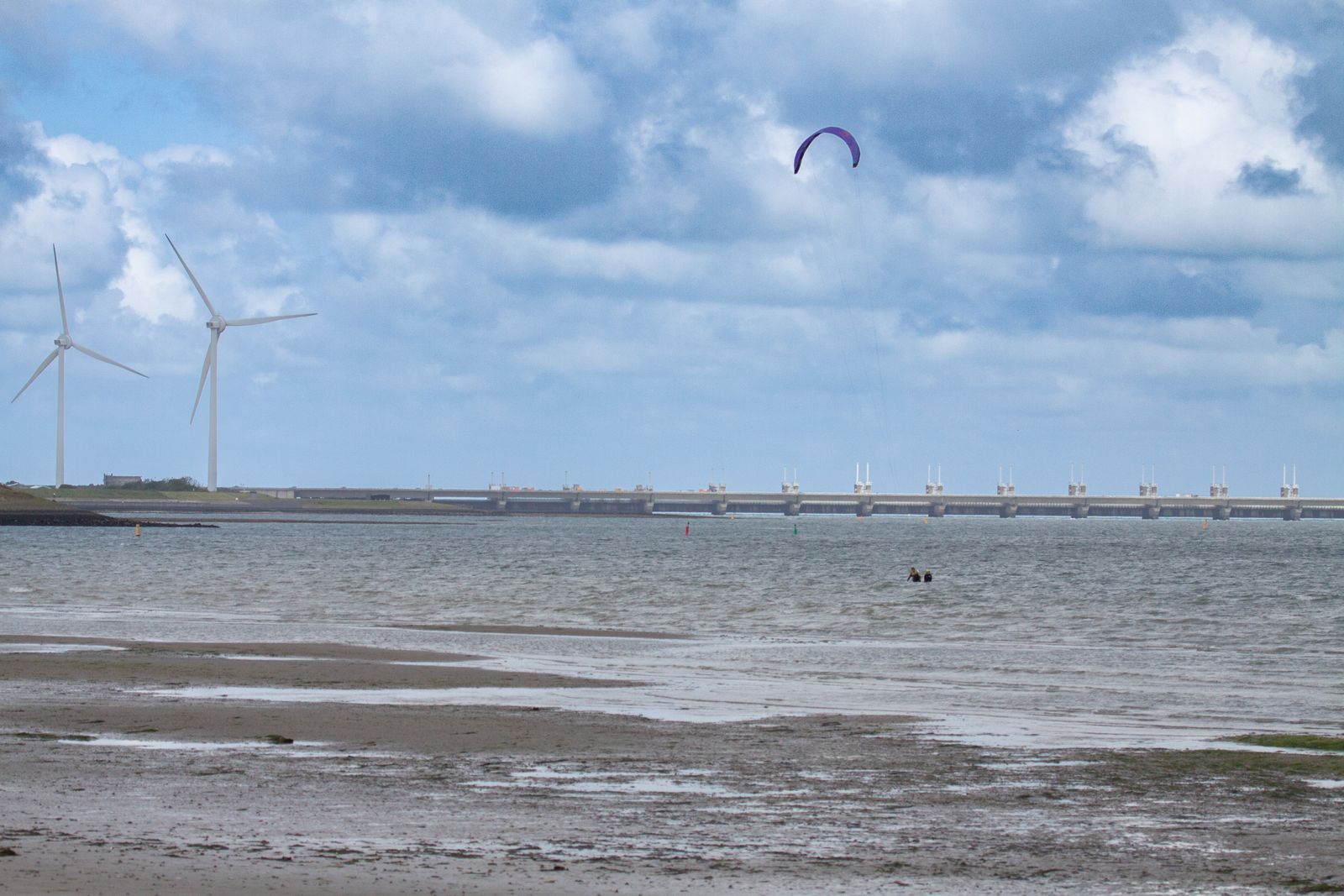
Flat, shallow water between yellow buoys on the Oosterschelde: great to learn, freestyle and foil — but only around low tide. At high tide it's out of bounds: the water pins you against the concrete dam, no escape (the local OBC club and police remind you). Always launch facing the water, boots for the oysters. Come with a tide plan.
North Sea waves for experts, with current: Zeeland's wave spot when the swell comes in. Not a place to learn.
The quiet, open end of the Zeeland coast, against the Belgian border and the Zwin reserve (next to Knokke-Heist): a wide beach, space to spare, deep water. The NKV rates it beginner-accessible — good for foil, waves, freeride and freestyle, with a sailing school by the Zwin. Don't confuse it with the neighbouring Vlamingpolder, which is advanced. Forget east wind.
Cadzand's raw eastern side: waves lined up by the groynes, current half-tamed by the posts, a spot that rewards good upwind riders. Mussel banks from the shore (wear boots), posts to watch at high tide. Not a place to learn — schools teach on the west side (Zwin). Forget east wind.
03Holland coast — the North Sea
From Hoek van Holland to IJmuiden, the Randstad coast lines up long, west-facing beaches a stone's throw from the big cities. Steady sea wind, chop to real waves depending on swell, strong and decisive tide. Cold water, current to watch near the piers — but easy after-work access.
At the river mouth, on Rotterdam's doorstep: a big beach behind the Europoort dam, gentler than the open coast, but with shipping traffic close by and, per some sources, shorebreak and current. Play it as an advanced spot; you can build up in mild conditions (SW/W), ideally supervised. East wind = offshore, pack up.
The big-format spot at the tip of the Tweede Maasvlakte: a smooth lagoon on one side, open sea and waves on the other, endless space. Almost every source calls it advanced-only (beginners are sent to Oostvoorne) — shifting depth, current on the sea side, no school or club (you're on your own). And above all: the nature reserve to the south is strictly off-limits.
The beginner side of the Voorne headland, right next to the Maasvlakte: an approachable beach (the Autostrand) with flat, shallow water you can stand in. This is where riders are sent to learn when the Maasvlakte next door is too much. It works from west to north-west; east wind, off the land, pushes you out to sea — skip it. Keep an eye on the tide.
Goeree's rugged side, under the Westhoofd lighthouse: a wide, open North Sea beach, ~2 m swell on average, punchy shorebreak and strong tidal current. Not a place to learn — a fast waterstart is essential. Schools that mention 'Ouddorp' often teach at Brouwersdam. For riders self-reliant in waves and current.
Voorne's versatile all-rounder: a wide family beach, dunes at sand level, and an offshore sandbank that breaks the chop and keeps the water fairly flat — a gift for learning. Beginners and advanced riders both fit in; a managed spot with lessons (NextLevel). East wind = offshore, pack up.
A riders' spot stretched along the boulevard: water that gets deep fast, waves and current, rated advanced by the NKV. Strict three-zone regime — you start from one of them and wear a coloured vest. The local trap is the Oude Rijn outflow; east wind, off the land, is a no.
The open North Sea in the heart of The Hague, under the lighthouse and pier: deep water, real waves and a treacherous rip (mui-stroming) that can catch you out — a riders' spot. You can learn supervised (a lessons zone at the Zuiderstrand), but the rule here is to be self-reliant. East wind = offshore, pack up.
The Hague's southern beach, wider and quieter than Scheveningen, with several schools open year-round. Shorebreak, waves and current in normal conditions — but at low tide the offshore sandbanks flatten the water and open a real window to progress. Rip currents and banks that shift from season to season are the thing to watch. East wind blows off the land, pack up. In season the launch zones are marked: read the signs at the beach entrance.
Just south of Kijkduin, the Zandmotor is a sand peninsula dumped in 2011 to feed the coast: behind it a shallow, flat-water lagoon has formed, cut off from the shorebreak. This is the region's learning ground, and a school teaches there all season. The lagoon works in almost every wind direction; in an east wind, straight off the land, it still runs but it turns gusty. In summer access is regulated and the sources disagree: read the signs at the beach entrance or call the school before you drive out.
The North Sea on Amsterdam's doorstep, sheltered behind the big Zuidpier: the pier breaks some of the waves and current, the water is flatter and you can stand far from shore — rare on this coast. A beginner can come supervised (after their first metres on flat water), especially in NW. But a busy shipping channel runs along the spot, and at high tide it chops up: then it's for advanced riders. Watch for rip currents (muien).
04The IJsselmeer — the great northern lake
To the north, the IJsselmeer — the former Zuiderzee closed off by a dyke — has become a vast, tide-free freshwater lake. Wide flat expanses, often shallow near the shores and far from the coastal crowds: a calm place to learn in summer.
On the Frisian shore of the IJsselmeer: the Workumerwaard offers flat, shallow freshwater with no tide — a calm spot to learn, mostly from May to September. It works from south-west to west; north-east, off the land, pushes you out.
Fourteen kilometres south of Workum, below the wooded Mirnser Klif cliff: a shallow bank where you can stand for nearly 600 m, which is why schools use it so much. The shore faces south, so it works from south-east to south-west, onshore or side-onshore; northerlies come off the land and push you out. The water stays flat, with some chop when it blows hard. Parking right by the spot, season May to September.
05Kitesurfing in the Netherlands by level
- Beginner
- Brouwersdam (sea side, at low tide), Cadzand-Bad West, Rockanje, Oostvoorne, Vrouwenpolder (at high tide) and Oesterdam (at low tide). And a school to start.
- Intermediate
- IJmuiden (supervised) and Rockanje when it's calm — the real stepping stones toward the North Sea.
- Advanced
- Waves, current and strong wind — Domburg, Cadzand Vlamingpolder, Hoek van Holland, Katwijk, Maasvlakte 2, Ouddorp, Scheveningen.
Just starting out? Spots in this country made our Top 20 places in Europe to learn kitesurfing →
06Delta or North Sea?
- The delta (Zeeland)
- Flat to choppy water, shallow, gentle or zero tide on the lakes, more sheltered. Ideal to learn, progress and freestyle.
- The North Sea
- Real waves, strong tide that paces the session, current near the piers, punchy west wind. Cold water. For waves and space.
In short: learning or want flat water → the Zeeland delta. Want waves → the North Sea coast.
07When to kite in the Netherlands — the wind calendar
- Spring (March–May)
- One of the best windows: depressions are still active, the water slowly warms. Cool but windy.
- Summer (June–August)
- Lighter and thermal, warmest water, packed beaches: perfect to learn, less so for big days. Check summer zones and hours.
- Autumn (Sept–Nov)
- The prime season: depressions return, it's the windiest time of year. Water still mild in September.
- Winter (Dec–Feb)
- Punchy and cold: for the well-equipped only (thick wetsuit, hood, gloves). The coast stays windy year-round.
08Planning your trip to the Netherlands
- Getting there (the road, not the plane)
- The heart of Dutch kiting is the Zeeland delta, and you get there by road. From Antwerp, Brouwersdam is ~70 km as the crow flies; from Rotterdam, ~45 km. If you fly in, Schiphol and Rotterdam-The Hague are the two gateways: allow around 1 h 30 by car from Schiphol to Brouwersdam. Once there, everything is close — 25 km from Brouwersdam to Vrouwenpolder, 54 km to Cadzand-Bad. The IJsselmeer is a separate trip: Mirns and Workum sit ~120 km north-east of Rotterdam.
- The zone rules (the real trap)
- Before anything else: kiting is banned along the entire coast and on all inland water unless permitted. That's the opposite of the French logic. Open zones are marked — signs at beach entrances, yellow buoys on the lakes — and mapped on the spotkaart of the Nederlandse Kitesurf Vereniging (NKV), the association that negotiates this access. Several waters close for nesting season: Lauwersmeer from 1 October to 1 June, Kornwerderzand from 1 October to 1 May, Medemblik and Hemmeland from 1 October to 1 April. Others only open outside the swimming season, like IJmuiden zone 2, which is kite-only from 1 October to 1 July. In a Natura 2000 area you stay inside the designated sector, no exceptions. And at Grevelingendam kiting is not allowed at all: it's windsurf and foil. NKV membership (€40-52/year) includes the liability insurance several spots require.
- The wetsuit (the real gatekeeper)
- It isn't the wind that sets your season here, it's the neoprene. Off Brouwersdam the water sits around 6 °C in January-February, 10 °C in April, 14 °C in May, 18 °C in June, then 20 °C in July-August before falling back to 15 °C in October and 7 °C in December. In practice: a 5/4 with hood, gloves and boots from November to April, a 4/3 in May and October, a 3/2 from June to September. August is the only month a shorty works, and even then not all day.
- The budget
- Dutch schools (IKO/VDWS certified) are everywhere and the pricing is readable: a discovery day runs about €100-150, a 3-day course €250-400, a 5-day course €400-600, gear included. Two to three days are enough to get going safely. If you then want your own kit, a complete new set (kite, bar, board, harness, 5/4) runs €2,450-3,900; second-hand, count €1,000-1,800. Lodging and food stay at Dutch prices, closer to Belgium than to Spain.
- Papers & connectivity
- Nothing to sort out: the Netherlands is in the EU and in Schengen. An ID card is enough for FR/BE citizens, mobile roaming costs nothing extra, euros everywhere. The only card worth having in your pocket is the NKV spotkaart.
- On the ground (the car and the tide)
- A car changes everything, because the right spot depends on the day's direction and each delta dam faces its water differently. The second reflex is specific to this country: on the coast and in the delta, the tide decides as much as the wind — Vrouwenpolder rides at high tide, Oesterdam at low tide, and the Brouwersdam lagoon only appears on the way down. On the IJsselmeer the question disappears: no tide. The live ranking accounts for both.
You don't fly in here, you drive, and that's the good news: you can cross the delta from one dam to the next in half an hour. Only two things catch newcomers out, and neither is the wind. First, the zone rules: in the Netherlands kiting is banned by default and allowed only where it says so. Second, the water. It drops to 6 °C in February. The rest — school, budget, papers — takes a few lines.
The rest — which spot is working today, for which level — is on the live ranking and each spot page above.
09Beyond the kite — the no-wind days
The Zeeland delta isn't a natural backdrop: it's a piece of engineering. On windless days you can go and see it, and the rest of the region fits inside an hour's drive.
- The Delta Works, up close
- The dams you rig on form one single system, built after the 1953 flood: Zandkreekdam, Veerse Gatdam, Grevelingendam, Brouwersdam, Oesterdam, Philipsdam and, at its centre, the Oosterscheldekering — the country's largest storm surge barrier, between Noord-Beveland and Schouwen-Duiveland. A road links them from one end of the delta to the other.
- Neeltje Jans
- The artificial island planted in the middle of the Oosterscheldekering, now a nature reserve with beaches and dunes where birds nest. The Deltapark on it tells the story of the barrier and of the 1953 flood, with an aquarium, seals and a boat trip on the Eastern Scheldt. It's the visit that explains the whole landscape you ride the rest of the week.
- The delta towns
- Veere, a tiny old harbour on the Veerse Meer, is worth the stop on its own. Middelburg is Zeeland's capital, Zierikzee still has its town gates, Domburg is the coast's historic seaside resort. Renesse and Vlissingen hold most of the lodging if you're looking for a base.
- Further north
- If you ride the IJsselmeer rather than the delta, you're in Friesland: the Mirnser Klif looks over the lake from its wooded cliff, and the Afsluitdijk, the 32 km dyke that closed off the old Zuiderzee in 1932, can be driven end to end. Amsterdam is an hour away.
10Frequently asked questions
Where to start kitesurfing in the Netherlands?
With a school, on approachable water: Brouwersdam (sea side, at low tide, when the sandbank forms a lagoon), Cadzand-Bad West, Rockanje, Oostvoorne, Vrouwenpolder at high tide or Oesterdam at low tide. (At Brouwersdam only the sea side is open to kiting; the lake side is reserved for foil and boards.)
What's the best kite spot in the Netherlands?
Brouwersdam is the benchmark: it works almost all the time (SW to NW). Kiting is on the sea side, where a sandbank breaks the waves — a flat, beginner-friendly lagoon at low tide; the lake side is reserved for foil and boards. But 'the best' depends on the day and your level — which is exactly what the live ranking above gives you.
When to kitesurf in the Netherlands?
The windiest stretch runs from autumn (Sept–Nov) to spring (March–May); summer is lighter but warmer, ideal to learn. The coast stays windy year-round for the well-equipped.
Does tide matter for kiting in the Netherlands?
Crucial on the North Sea coast (a spot can go from perfect to unrideable), but absent on the delta lakes like the Grevelingenmeer — one of Zeeland's advantages for beginners.
Is the water cold in the Netherlands?
Yes: reckon on a 4/3 mm wetsuit much of the year, 5/3 with hood and gloves in winter. Water is mildest in late summer.
Do you need a licence to kite in the Netherlands?
No national permit, but many beaches are regulated (marked zones, seasons, Natura 2000 reserves) and some require a local pass. Schools issue IKO/VDWS levels. Always check the spot's rules.