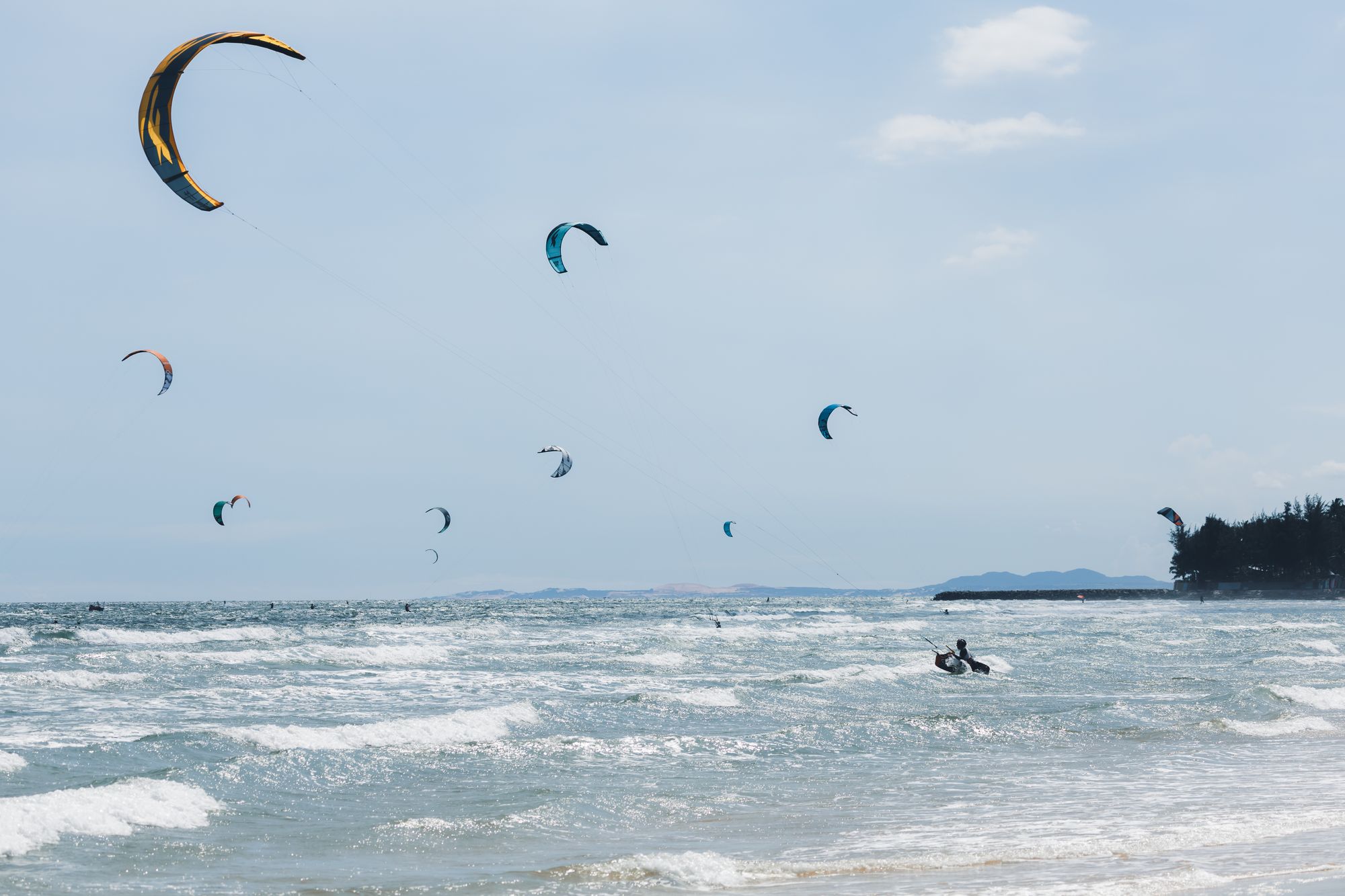
At the very north, hard against the Belgian border, Bray-Dunes rolls out a big flat beach lined with dunes — the Franco-Belgian kite corridor. North Sea chop, working wind from north to north-west, easy access from Dunkirk. An open spot to cover ground; time it on the tide, which uncovers a wide foreshore.
KITESURF
Kitesurfing in France: every spot, and which ones are working right now
France is two seas with opposite tempers, an ocean that breathes with the tides, and flat lagoons set between the two. From the windy North Sea to the Languedoc lagoons, by way of the Landes beach-breaks and the flat water of the Vendée, there's enough here to ride all year — provided you pick the right spot on the right day. That's the point of this guide: not just where to kite in France, but which spot is working today, for your level. Every spot below is rated live by KiteReady — wind, direction, tide — and ranked from most to least rideable, right now.
Live
Which spots are working right now?
Ranked by live score · pick your level
- 1Wimereux — Côte d'OpalechopApr – Oct22ktONOGO
- 2Wissant — Cap Gris-NezchopApr – Oct24ktONOGO
- 3NoirmoutierchopJan – Dec20ktONOGO
- 4Bretagne — Baie d'AudiernewavesMay – Sep14ktOGO
- 5Le Touquet-Paris-PlagechopJan – Dec22ktONOGO
- 6LeffrincouckechopJan – Dec27ktONOGO
- 7Leucate Gouletflat waterApr – Oct13ktONOGO
- 8La TorchechopJan – Dec13ktONOGO
- 9Almanarre — Presqu'île de GienschopApr – Oct17ktONOGO
- 10Noirmoutier — La Guérinièreflat waterMar – Nov16ktONOGO
- 11Bray-Dunes — Côte d'OpalechopApr – Oct27ktONOGO
- 12Lacanau — Plage NordwavesMay – Oct8ktOGO
- 13Biscarrosse — Plage NordwavesMay – Sep8ktONOGO
- 14Hyères — La Capte / Presqu'île de Giensflat waterApr – Sep23ktONOGO
- 15Base Hydravion Saint-LaurentchopMar – Oct12ktNOBORDERLINE
- 16La Palme Étangflat waterApr – Oct13ktONOBORDERLINE
- 17Camargue — Plage de Beauducflat waterMar – Nov17ktONOBORDERLINE
- 18DunkerquechopJan – Dec26ktONOBORDERLINE
- 19Leucate — Le Barcarèsflat waterMar – Oct13ktNOBORDERLINE
- 20LeucatechopMar – Oct14ktNOBORDERLINE
- 21Leucate La FranquiwavesApr – Sep14ktONOBORDERLINE
- 22Palavas-les-FlotschopApr – Oct11ktONOBORDERLINE
- 23Capbreton — La PlagechopMay – Oct7ktONOT RECOMMENDED
- 24Gruissan — Plage des Chaletsflat waterMar – Nov13ktONONOT RECOMMENDED
- 25Hendaye — PlagechopJan – Dec8ktOSONOT RECOMMENDED
- 26Hossegor — Les EstagnotswavesSep – Nov7ktONOT RECOMMENDED
- 27Marseillan Plage — HéraultchopMar – Oct6ktNONOT RECOMMENDED
- 28Étang de Thau — Mèzeflat waterApr – Oct7ktNONOT RECOMMENDED
01How to pick your spot
Four questions are enough to know whether a spot suits you on a given day:
- Your level
- A beginner wants shallow water to stand in, steady wind and space; an advanced rider is after waves or strong wind. The same spot can be a playground or a trap depending on where you are.
- The water
- Flat (lagoon, étang) = ideal to learn and to freestyle. Chop = versatile. Waves = for those who can handle the shore-break.
- Wind direction
- Onshore (pushing you to the beach) reassures a beginner; side-shore (along the beach) is the most comfortable; offshore (pushing you out to sea) is out of the question without a rescue boat.
- The tide
- On the Atlantic and the Channel it changes everything: a spot that's magic at mid-tide can be unrideable at high tide. In the Mediterranean you forget about it — it's negligible.
KiteReady folds these four parameters into every spot's score, recalculated continuously.
02North — Côte d'Opale & the North Sea
From Le Touquet to the Belgian border, this is wind country: statistically France's windiest coast, with vast beaches at low tide. Cold, choppy water, a strong and decisive tide, wind usually from the north-to-west sector. Thick neoprene for much of the year — but when it blows, it blows for everyone.
From Malo-les-Bains to Leffrinckoucke, a run of big beaches that rescues plenty of North Sea sessions. It works best when the wind stays side to side-onshore, anywhere from north-east to west depending on exactly where you set up. The tide dictates comfort: at low tide the exposed foreshore leaves room to rig and get clear of the shore, at high tide everything tightens and you need to be sharper. ⚠️ Summer rules: from 1 July to 31 August riding is confined to a 500 m 'kitepark' west of the lifeguard post, while east of the Leffrinckoucke sea wall, in the bunker dune area, it stays open all year.
The legendary Côte d'Opale spot, tucked between Cap Gris-Nez and Cap Blanc-Nez. This is where the crossings to England start. Often muscular north to north-west wind, honest chop, a tide to read. For comfortable riders, in a setting you have to earn.
Two spots in one: on south to south-west it throws up good waves; on north-west it's calmer, freeride ground. The Côte d'Opale that hosts the Engie Kite Tour, good atmosphere. Keep an eye on the tide.
Le Touquet's huge beach has a rare advantage on this coast: it can be ridden at any state of the tide. The best directions run from south through west to north. Two reflexes: favour the zone north of the Aqualud to stay clear of the swimming area closed to water sports, and avoid the southern sector at high tide, where the sea comes up too close to the houses and shops.
03Brittany
Jagged coast, clean water, Atlantic swell: Brittany has to be earned. Exposed spots, usually for riders comfortable in waves and tide, but they pay back with wild sessions and a rare consistency of wind.
The point closing the Baie d'Audierne to the north, in southern Finistère: Brittany's best-known board-sports spot. The beach faces due west and so catches every swell, from north to south, more or less all year — which is both its reputation and its difficulty. The wind is steady almost permanently. The cleanest windows run October to April, when the wind swings east or the morning stays calm. Come knowing the day's swell.
The big Atlantic in full force: 2 to 4 m swell, a south-west wind that flattens your hair, an open and wild bay. For advanced riders at ease in waves and overpower only. Cold water (12-18 °C, 5 mm mandatory), heavy tidal currents, zero facilities: self-reliant or nothing.
04Atlantic — Vendée & Charentes
Around Noirmoutier, the finest flat water on the Atlantic seaboard: sheltered behind the islands, perfect to progress, provided you work with the tide. This is where people are often sent to learn on the Atlantic.
On the marsh side the water is flat and shallow — ideal ground to lay your first foundations in the Vendée, quietly. It works from south-east to west-south-west. The tide runs everything: on big coefficients the muddy shallows dry out. The thermal can drop dead at the end of the day.
05Atlantic — Landes, Gironde & Basque Country
The beach-break coast: sand as far as you can see, powerful swell, thermal wind in summer and depressions in autumn. Big playground for wave riding, mostly intermediate and advanced. The strong season is autumn. Hendaye, further south, offers more sheltered water, good to learn on.
Serious Landes beach break: 2 to 4 m swell, north-west wind, advanced ground only. The baïnes are the real danger — those outgoing currents that make recovery hard; never ride alone and read the flags. Unpredictable and powerful, but a genuine wave school.
A long Landes beach, quieter than Lacanau, full Atlantic. The thermal north-westerly settles in regularly in summer, over beach-break waves that can be moody. Lateral currents and a nearby military zone to respect. Good wave ground for intermediates who want space.
Europe's surf capital, and you feel it in the water: world-class beach breaks, powerful and unpredictable. Kiting in powered conditions, advanced only, without getting in the surfers' way. Best windows from September to November. Baïnes and outgoing currents: maximum vigilance.
Easy access and a steady north-westerly: a good chop-and-wave compromise for intermediates. But the gouf — that undersea trench right off the shore — generates serious currents: avoid heading out off the harbour and its traffic. Read right, a versatile and practical Landes spot.
On the Spanish border, a big sheltered bay, far gentler than the neighbouring beach breaks. The south-westerly comes in steady without being brutal: good ground to learn, real facilities, family atmosphere. Lots of swimmers in summer, and rules that change on the Spanish side.
06Mediterranean — Occitanie & the Camargue
The heart of French kiting. From the Camargue to Leucate, the tramontane and the mistral sweep flat lagoons and sand beaches with almost no tide. Leucate means ~300 windy days a year and several stretches of water for every level. Best seasons: spring and autumn, when the land winds settle in.
The historic cradle of French kiting, a safe bet: flat, shallow water on the lagoon side, perfect to progress, ringed with schools. The north-west tramontane is steady — but it's a land wind (offshore): stay inside the zone, watch your drift, share the water in summer.
The big wild spot of the Rhône delta, one of the finest kite experiences in France. Flat water in the shallows, mistral often muscular (30+ knots). Access has to be earned — sandy track, 4x4 recommended — and you're far from any rescue. Protected nature zone: respect the areas closed off for birds.
Standing depth everywhere on flat, shallow water: the reference learning spot of the area. It works from the west to north-west sector. A Natura 2000 site — you respect the habitat. Ideal for first sessions as much as for progression.
Leucate's committing seaward face: an exposed spot, deep water, real waves when swell comes in. The tramontane blows offshore here — a rescue boat is mandatory when it's on, and it's for self-reliant riders only. No tide, but a genuine demand for self-sufficiency.
On the étang: flat, shallow water, the venue of the Mondial du Vent. Open to everyone on tramontane — but it often comes in very gusty, a workout to handle. No tide. The resort's reference learning spot when the wind fills in.
The étang de Salses, on a 1927 former seaplane base: character, and sheltered water. The tramontane comes through side-shore. Two traps: the concrete pontoon on the left, and a slippery weed bottom near the shore. Military base next door — drones banned. No tide.
The lagoon: flat, shallow, buoyed water, the learning spot par excellence on the étang side. Ideal for the very first lessons. Respect the zones. The late-day thermal can stop dead — don't hang around too far out.
The largest lagoon in the Languedoc, flat and shallow, with wide sandbanks where you find your feet with no obstacles and no current. A trap to know before loading the car: at Mèze the north-west tramontane is a land wind. The spot mostly works on southerly winds — the south-east marin, the south to south-west thermal — which come straight onshore. On tramontane days you go elsewhere on the étang. The water is clearly warmer than the sea in season, and the window runs from March to October.
Wedged between the étang de Thau and the open Mediterranean: take your pick, the lagoon's flat water or the open sea. The mistral lands well oriented here, a good technical spot. Careful when it builds (30+ knots) and with sharing the two bodies of water.
The closest to Montpellier: convenient, but to be handled with a clear head. The mistral arrives well oriented, funnelled between the buildings — hence unpredictable gusts. A regulated and very busy spot in summer. Perfect for a quick session when it blows, not to learn alone.
07Mediterranean — Var & Côte d'Azur
Further east, l'Almanarre is the star spot: a double body of water that works on mistral as well as on easterlies, flat on the étang side for beginners, more committing on the open side. Warmer water, a gentler mood than the Languedoc.
The star spot of Giens, a competition landmark. Steady, reliable mistral over moderate chop, full facilities: serious ground to progress technically. When it builds (30+ knots), for intermediates and advanced; aim for the morning for steadier wind, and mind the race area.
On the other side, La Capte faces the Pesquiers lagoon: flat, shallow water, the Var's ideal learning spot. Steady mistral from March to October. Two things: offshore drift on land wind, and the Toulon-Hyères airport flight path (low aircraft possible). Very busy in summer.
08Kitesurfing in France by level
- Beginner
- Flat, shallow water, side/onshore wind — Leucate (Le Goulet), Le Barcarès, La Palme, the étang de Thau at Mèze, Almanarre on the lagoon side, Hyères — La Capte, Noirmoutier (watching the tide). And a school to start.
- Intermediate
- Chop and wide water — Gruissan, Marseillan, Palavas, Biscarrosse, Capbreton, Almanarre, Dunkirk, Le Touquet.
- Advanced
- Waves and strong wind — Hossegor, Lacanau, La Torche, Baie d'Audierne, Leucate La Franqui, Wissant.
Just starting out? Spots in this country made our Top 20 places in Europe to learn kitesurfing →
09Mediterranean or Atlantic?
- Mediterranean
- Negligible tide, little swell, warmer water; land wind (tramontane, mistral) gusty but strong, mainly spring and autumn. Ideal to learn and to freestyle.
- Atlantic & Channel
- A strong tide that paces every session, real swell, cooler water; steady westerly wind, best in autumn. For waves and space.
In clear terms: starting out or after flat water → Mediterranean or the Vendée lagoons. After waves → Atlantic.
10When to kite in France — the wind calendar
- Spring (March–May)
- The best window in the Mediterranean: tramontane and mistral settle in. Cool but windy.
- Summer (June–August)
- Lighter in the Mediterranean (afternoon thermal breezes), perfect to learn in warm water; north-west thermals in the Landes.
- Autumn (Sept–Nov)
- The Atlantic's prime season, when the depressions return. The Mediterranean picks up hard again too.
- Winter (Dec–Feb)
- Muscular everywhere, cold water; the North and the Channel stay windy all year.
11Planning your trip to France
- The tide (the real subject)
- This is the variable that exists nowhere else in this guide and that decides everything in the north and the west. On the Channel and the Atlantic, the same spot changes nature in six hours: at Noirmoutier the muddy shallows dry out on big coefficients, at Dunkirk the foreshore that's wide open at low tide closes up completely at high tide, at Le Touquet you can ride at any tide but the southern sector becomes unusable as the water rises. In the Mediterranean you can forget the word: the tidal range is negligible, which is why the Languedoc lagoons are the country's favourite learning ground. The live ranking folds the tide in spot by spot.
- The licence and the summer zones
- There's no kitesurfing permit, but an FFVL licence with third-party liability is required to ride, and it's also what opens access to certain zones. The prices are modest: €16 for the school-course licence (9 non-consecutive days over 2 months), €17 for the pupil licence, €43.50 for a first self-reliant rider's licence, €53.50 on renewal, and €5 for a 'contact day' pass. Second point, trickier: many beaches switch to a summer regime. At Dunkirk, from 1 July to 31 August, riding shrinks to a 500 m 'kitepark' west of the lifeguard post, while east of the Leffrinckoucke sea wall it stays open all year. At Le Touquet you ride north of the Aqualud to stay out of the swimming area. Read the sign at the beach entrance before you unroll.
- The wetsuit, coast by coast
- A received idea to correct: the Mediterranean is not warm in winter. Off Leucate the water drops to 12-13 °C in February, against 11-12 °C at Lacanau and 8 °C at Wissant. The real gap opens up in summer: Leucate climbs to 23 °C in July-August, Lacanau to 20-21 °C, Wissant tops out at 19-20 °C. In practice, a 4/3 covers the Mediterranean and the Atlantic from October to May, a shorty or a 3/2 in summer. Up north, pack a 5/4 with hood and gloves from December to March, and keep a 4/3 until May. Inland water changes things: on the étang de Thau the water is clearly warmer than the sea in season.
- The budget
- A three-day beginner course in a small group runs between €250 and €600 depending on season, region and group size, gear and insurance usually included. In the north and west, four sessions of 3 to 4 h come to around €300-350 if you book midweek outside school holidays. A two-hour private lesson at an FFVL school runs €90-150. Add the licence, a few euros, and lodging at regional rates — the Languedoc coast in August is nothing like the Côte d'Opale in March.
- Getting there & papers
- From Belgium, the Netherlands or Germany, the Côte d'Opale is a drive you barely think about, and that's the north's real argument: Bray-Dunes touches the Belgian border. For the Mediterranean, flying or the TGV from Paris makes sense — Montpellier, Perpignan and Toulon are the gateways to the Languedoc and the Var. The Atlantic seaboard revolves around Bordeaux and Nantes. On paperwork, nothing: EU and Schengen, an ID card is enough, mobile roaming included, euros everywhere.
- Picking your coast by season
- In spring and autumn, aim for the Mediterranean: tramontane and mistral settle in, and Leucate posts ~300 windy days a year. Autumn is also the Atlantic's prime season, when the depressions come back to feed the Landes beach-breaks. In summer the Mediterranean lightens into afternoon thermal breezes — the right moment to learn in mild water — while the thermal north-westerly works in the Landes. In winter everything turns muscular and the north stays windy, but it's the neoprene that decides.
France isn't one destination, it's three. The Channel and North Sea up north, the Atlantic to the west, the Mediterranean to the south: three wind regimes, three water temperatures, and above all two opposite relationships with the tide. Choosing your coast is already 80 % of a successful trip. The rest comes down to a few points, two of which foreign guides systematically forget: the licence and the summer zones.
The rest — which spot is working today, for which level — is on the live ranking and each spot page above.
12Beyond the kite — the no-wind days
Three coasts, three hinterlands. Enough to fill a day off without ever driving far.
- Côte d'Opale
- The two capes, Gris-Nez and Blanc-Nez, frame the bay of Wissant: cliffs, ridge paths and England visible on a clear day. At Boulogne-sur-Mer, Nausicaá is Europe's largest public aquarium — 10,000 m² of exhibition space, 60,000 animals from 1,600 species, and a main tank of 10,000 m³.
- Brittany
- From La Torche, the Pointe du Raz is under an hour away: Brittany's western tip, where the moor drops into the Atlantic. The Bigouden country around Pont-l'Abbé, with its headdresses and fishing harbours, fits between two tides. Locronan, a granite village inland, is worth the detour on a rainy day.
- Landes & Gironde
- The Dune du Pilat, at the entrance to the Arcachon basin, is Europe's highest dune at 110.9 m — and the only one on the Aquitaine coast still moving, advancing one to five metres a year. Bordeaux is an hour from the beaches, and the Landes forest can be crossed by bike on flat trails that run out of sight.
- Occitanie & Provence
- The Cité de Carcassonne, UNESCO-listed in 1997, lines up 52 towers and 3 km of ramparts less than an hour from Leucate. The Canal du Midi, listed in 1996, links the Mediterranean to the Atlantic over 360 km and 328 engineering structures built between 1667 and 1694; you walk or cycle it under the plane trees. On the delta side, the Camargue is explored on horseback among flamingos and salt pans. Further east, from Giens, the islands of Porquerolles and Port-Cros are a short ferry away.
13Frequently asked questions
Where to start kitesurfing in France?
On flat, shallow water with a school: the étang de Leucate, the étang de Thau at Mèze, l'Almanarre, Hyères — La Capte, or Noirmoutier while watching the tide.
What's the best kitesurf spot in France?
Leucate is the benchmark (~300 windy days a year, several stretches of water), but 'the best' depends on the day and your level — which is exactly what the live ranking above gives you.
When to kitesurf in France?
Spring and autumn in the Mediterranean; autumn on the Atlantic; all year in the North for the well equipped.
Mediterranean or Atlantic to learn?
Mediterranean: no tide to manage, flat water. Watch out though for the warm-water myth — in February, Leucate sits at 12-13 °C.
Do you need a certificate or licence to kite in France?
No permit, but an FFVL licence with third-party liability is required, and it conditions access to certain zones. Count €16 for a school course, €17 for a pupil licence, €43.50 for a first self-reliant rider's licence and €53.50 on renewal. Always check the spot's local rules.
Does the tide matter for kitesurfing in France?
Crucial on the Atlantic and the Channel (a spot can be unrideable at high tide), negligible in the Mediterranean. It's the first question to ask before choosing your coast.
Can you kite year-round on the Côte d'Opale?
The wind, yes: statistically it's France's windiest coast. It's the water and the rules that limit you. The water drops to 8 °C in January-February off Wissant, which means a 5/4 with hood and gloves. And in summer several beaches switch to restricted zones — at Dunkirk, riding shrinks to a kitepark from 1 July to 31 August.