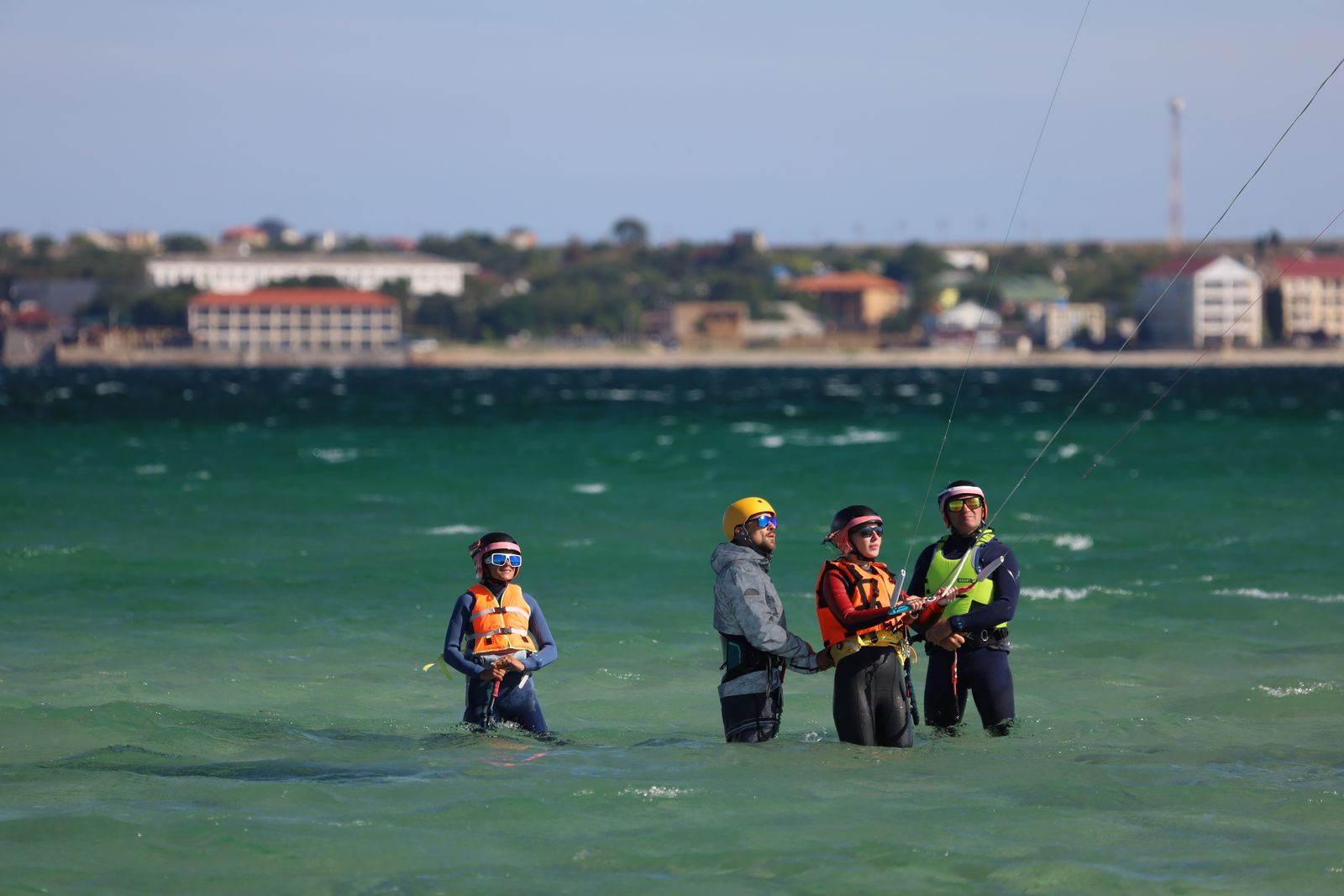
Europe's 20 best spots to learn kitesurfing
Where can you learn to kitesurf in Europe without fighting the sea? We combed through nine regions, from Portuguese lagoons to Danish fjords: the real universe of places where a beginner can learn runs past a hundred spots — yet most "top lists" recycle the same five names. Here is our ranking, built on four forgiving criteria: you can stand, the water is flat, no offshore trap, a school on site. And every spot lives on KiteReady — you see its live score before you go.
The three perfect lagoons
Three bodies of water have it all: standable far out, flat in any weather, dependable wind, resident schools. If you only remember three names for your learning week, make it these.
- 01 · Lo StagnoneMarsala, Sicily — Italy
- Europe's largest flat lagoon, set among salt pans and windmills. The water stays hip-deep for kilometres, the thermal blows close to 300 days a year, and a row of schools lines the shore. The Mediterranean's learning factory — our number 1, no hesitation.Open the spot page · live score
- 02 · Mar Menor — Los NarejosMurcia, Spain
- An enclosed lagoon, warm all year (never below 18 °C), so shallow you can stand far from shore. Its secret weapon: even a badly oriented wind never takes you out to sea — it pushes you across waist-deep water to the far bank. Spain's most reassuring spot.Open the spot page · live score
- 03 · Nin — Ninska LagunaZadar, Croatia
- A sand lagoon where you can stand 200 metres out, and which stays flat even when the wind picks up. The thermal maestral rises in the afternoon, the water warms fast, and the old town of Nin sits next door. The beginner reference of the whole Adriatic.Open the spot page · live score
The safe bets
Seven spots you can book with your eyes closed: lagoons and lakes that tick nearly every box, each with a character of its own — Sardinian Mistral, Portuguese Nortada, Languedoc sun or Frisian light.
- 04 · Punta TrettuSardinia, Italy
- A lagoon flat as a table where you can stand hundreds of metres out, swept by a steady Mistral. The place in Italy to learn without ever fearing the water.Open the spot page · live score
- 05 · Lagoa de ÓbidosSilver Coast, Portugal
- Ninety minutes from Lisbon, a lagoon sheltered from the Atlantic swell where the Nortada blows almost daily in summer. You can stand, the water is smooth — just mind the regulated zones from 15 June to 15 September; the school sets you up in the right place.Open the spot page · live score
- 06 · Étang de Thau — MèzeLanguedoc, France
- The lagoon side of Thau: standable sandbanks, water much warmer than the sea, and the Marin blowing dead onshore, pushing you back to the bank. A reference school has taught here since 1998. When the Tramontane blows (offshore here), you stay on the beach — the one rule.Open the spot page · live score
- 07 · Fuerteventura — SotaventoCanary Islands, Spain
- The dream lagoon: a turquoise arm of water trapped behind a sandbar, filling on the rising tide into a standable mirror. Here you read a tide table more than a forecast — high tide is your slot, and you stay inside the lagoon; the ocean is on the other side.Open the spot page · live score
- 08 · Workum — WorkumerwaardFriesland, Netherlands
- A closed lake: zero tide, zero current, knee-deep water for hundreds of metres. The nursery of Frisian kitesurfing, with an official kite zone and a resident school.Open the spot page · live score
- 09 · Suhrendorf — UmmanzRügen, Germany
- Germany's largest standable water: a sheltered bodden roughly 400 metres by 12 kilometres where you can nearly always stand. Bonus: sunsets flaring behind Hiddensee.Open the spot page · live score
- 10 · Bork HavnRingkøbing Fjord, Denmark
- A giant shallow bathtub at the south end of the fjord, sealed off by the Hvide Sande lock: no tide, knee-deep water, and the historic WestWind school on the shore. Denmark's learning classic.Open the spot page · live score
A little more wind to handle
Five superb spots that ask for a touch more attention: a thermal that strengthens in the afternoon, a lagoon that lives with the tide, or a local wind with moods. Nothing disqualifying — the local school knows the tune.
- 11 · Gökova — AkyakaMuğla, Turkey
- Every summer afternoon the westerly thermal funnels up the gulf and lands neatly on the beach: flat water, sandy bottom, green mountains behind. Pitch your kite, wait for noon, the wind comes to fetch you.Open the spot page · live score
- 12 · Ria de AlvorAlgarve, Portugal
- The real learning ground of the Lagos area: a sheltered tidal lagoon with standable sandbanks. The wind's character changes with where you rig — this is a spot you learn with the local school, and it pays you back.Open the spot page · live score
- 13 · Ebro Delta — TrabucadorCatalonia, Spain
- A six-and-a-half-kilometre sand spit in the heart of the natural park: the sea on one side, the Alfacs bay on the other — a giant shallow mirror. You ride the bay side, of course.Open the spot page · live score
- 14 · Tarifa — Los LancesAndalusia, Spain
- The teaching beach of Europe's kite capital: a vast arc of sand, a density of schools unmatched anywhere, and the onshore Poniente to learn with. When the Levante kicks in, the water sharpens and the level rises — that's when you hand the spot to the experienced crowd.Open the spot page · live score
- 15 · Mikri ViglaNaxos, Greece
- One of the windiest stretches of water in the Mediterranean: the Meltemi arrives side-onshore over a shallow bottom. Perfect for learning in steady, punchy wind — aim for June or September if you'd rather start gently.Open the spot page · live score
The good calls that complete the map
Five addresses that earn their place: less "perfect" on paper than a closed lagoon, but ideal if they're on your route — and some are true national references.
- 16 · Torre San GiovanniSalento, Italy
- White sand, turquoise water, and a string of islets 500 metres out enclosing a shallow, quiet play-pool: the beginner postcard of the Ionian Sea, with a year-round school.Open the spot page · live score
- 17 · Kos — PsalidiDodecanese, Greece
- The most punctual wind in the Aegean: the Meltemi clocks in at lunchtime and the water stays flat along the beach. It strengthens through the afternoon — beginners ride the morning and the early breeze; the school sets the schedule.Open the spot page · live score
- 18 · Lanzarote — Costa TeguiseCanary Islands, Spain
- A horseshoe bay, flat and shallow over pale sand, at the foot of a black lava island. You learn inside the bay; the Atlantic and its waves wait beyond the wall, for later.Open the spot page · live score
- 19 · Hyères — La CapteVar, France
- The gentle back side of the Giens peninsula: translucent, shallow water and a family feel. The easterly wind makes this spot work; in a Mistral (offshore here) you stay ashore — the exact opposite of l'Almanarre across the strip.Open the spot page · live score
- 20 · BrouwersdamZeeland, Netherlands
- THE Dutch reference: an offshore sandbar kills the waves and, at low tide, the beach turns into a near-lagoon. From SW to NW there is nearly always a working angle. One caution: kites are banned on the lake side — everything happens on the sea side.Open the spot page · live score
What makes a true beginner spot
A beginner spot is not "a beach with wind". It is a body of water that forgives mistakes. Four criteria decided this entire ranking — and any hidden trap (offshore wind, current, tide window) sends a spot tumbling, however pretty the photo.
- You can standthe king criterion
- Relaunching a kite while standing changes everything: less fear, less fatigue, three times more attempts per hour. Lagoons where you can stand hundreds of metres out are kitesurfing's true classroom.
- The water is flatno chop, no waves
- On flat water the board doesn't slap, the kite sits steady, and every waterstart attempt begins from a clean position. An enclosed lagoon beats any ocean beach for learning.
- No offshore trapsafety first
- Offshore wind pushes you out to sea — THE beginner danger. The spots in this ranking work with winds that bring you back to shore, or sit in closed bays where drifting only takes you to the far bank.
- A school on siteand rescue if needed
- Every address here has at least one active school on the spot: proper gear, marked zones, a rescue boat. Learning alone costs you weeks and adds risks you don't need.
Before you book your week
The questions that come up every time someone decides to learn — short answers, no detours.
- What is the best spot in Europe to learn kitesurfing?
- On paper, Lo Stagnone in Sicily: Europe's largest standable lagoon, wind almost daily and schools everywhere. But the "best" spot is above all the one that will have wind during YOUR dates — which is exactly why every spot page in this ranking shows a live score.
- What is the best season to learn in Europe?
- May to September for the vast majority of the ranking: the Mediterranean thermals and the Meltemi run all summer, and the northern lakes (Netherlands, Germany, Denmark) are ridable May to September. The Canaries add the summer trade wind and mild winters — the ranking never really sleeps.
- How long does it take to learn kitesurfing?
- Count 3 to 5 days of lessons to become an autonomous beginner (waterstart and first runs). On a spot where you can stand, it goes distinctly faster: you retry without swimming, without stress. That is criterion number 1 of this ranking.
- Is a "beginner" spot a beginner spot in any weather?
- No. A lagoon you can stand in under a steady 15 knots is nothing like beginner-friendly in gusty 30, and a wind turning offshore makes a trap of the finest spot. That is why KiteReady's scores cap the number the moment gusts or direction go wrong — check the day's colour before you drive.