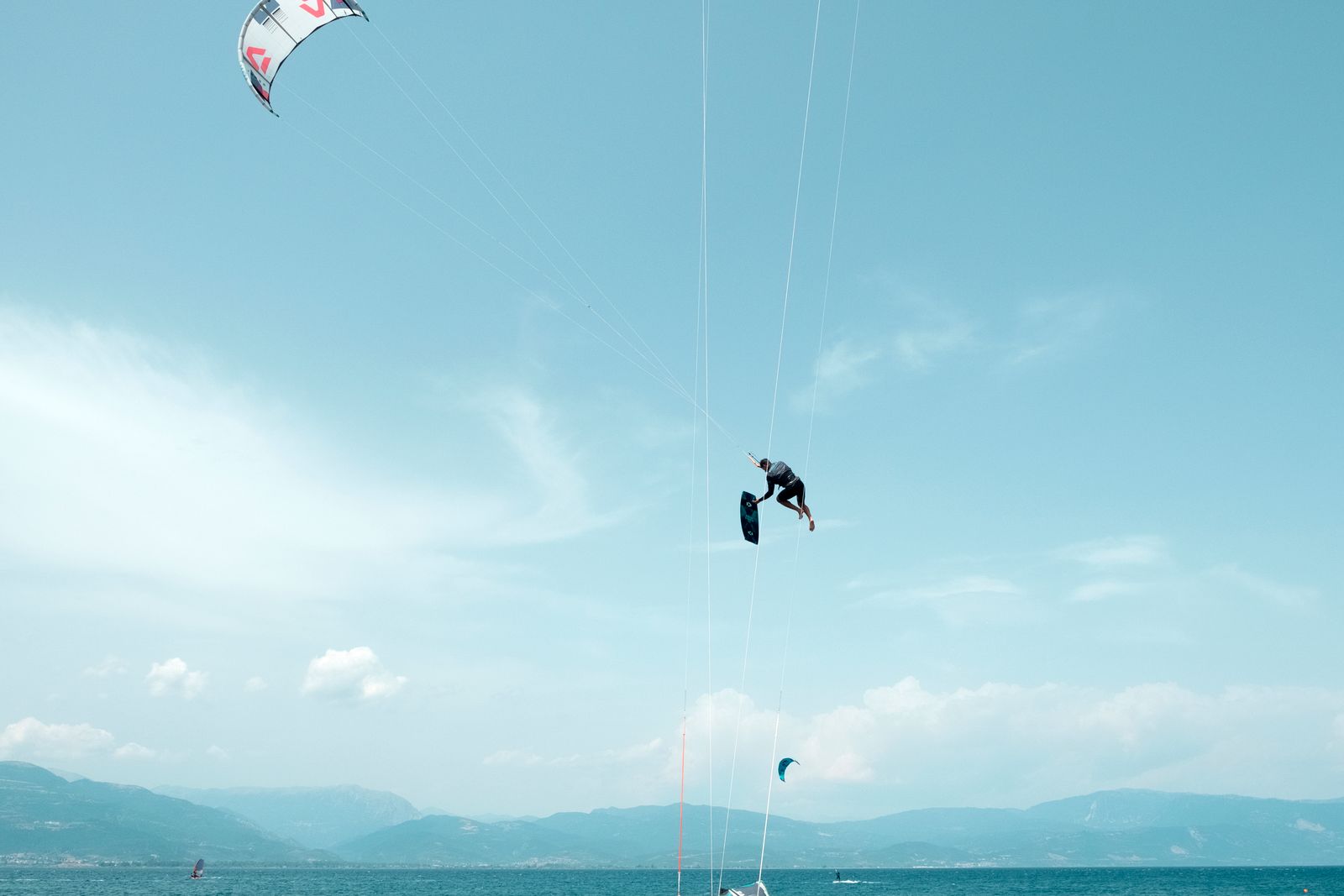
A wild 3 km bay in the northern Aegean, probably Greece's most forgiving spot: waist-deep water far from shore, clean sandy bottom with no rocks, afternoon thermal Meltemi (16-25 knots). Table-flat to the north for freestyle, small waves to the south, side-onshore — you always get back. A paradise to learn and progress.
KITESURF
Kitesurfing in Greece: every spot, and which ones are working right now
Greece in summer runs on a single engine: the Meltemi. This north wind settles over the Aegean from May to September and blows for weeks at a stretch, strong and steady — which is what makes the Greek islands one of Europe's sure bets for kiting. Many spots share the same layout: a flat, shallow lagoon to learn on one side, open sea and waves on the other. On the Ionian side (Lefkada) it's gentler: more approachable afternoon thermals. Tide is negligible here; what matters is the day's wind and your level. Every spot below is rated in real time by KiteReady — wind, direction — and ranked from most to least rideable, right now.
Live
Which spots are working right now?
Ranked by live score · pick your level
- 1Karpathos — AgrilaopotamoschopMay – Sep5ktNONOT RECOMMENDED
- 2Kos — Psalidiflat waterMay – Sep3ktNNONOT RECOMMENDED
- 3Lefkada — Agios IoannischopMay – Oct3ktSSONOT RECOMMENDED
- 4Limnos — Kerosflat waterJun – Sep10ktNENOT RECOMMENDED
- 5Mikri Vigla — Naxosflat waterJun – Sep8ktNNOT RECOMMENDED
- 6Rhodes — PrasonisimixedMay – Sep7ktNONOT RECOMMENDED
01How to pick your spot
Four questions are enough to know whether a Greek spot suits you on a given day:
- Your level
- Many spots have a flat lagoon to learn AND open sea for advanced riders — as long as you ride the right side. The Meltemi can blow hard: what's gentle in the morning turns punchy in the afternoon.
- The water
- Flat, shallow lagoon = ideal to learn and freestyle. Waves (open-sea side) = for those who handle the break and cross-shore wind.
- Wind direction
- Side-onshore reassures and brings you back to shore; cross-offshore (as off some lagoons) takes you out to sea and demands skill.
- Season & the Meltemi
- The Meltemi blows May to September, peaking in July-August (often 20-30 knots, sometimes more in the Aegean). Off-season, wind is rare. On the Ionian side, it's gentler thermals.
KiteReady folds wind and its direction into every spot's score, recomputed continuously.
02The Aegean — Meltemi country
This is the heart of Greek kiting: islands swept by the Meltemi all summer, strong and steady wind for weeks, and those two-faced spots (flat lagoon / open sea) the country is known for. It blows well, sometimes too well — pick your island and your side by your level.
On the northeast coast of Kos, near the town: the spot that guarantees your session when others are waiting (venturi effect between the islands). Mornings belong to beginners — light wind, shallow water near shore, schools running. Then the Meltemi builds around midday (15-23 knots, side-shore) and it becomes intermediate ground, with chop as soon as you head out.
On the Afiartis plain, the Meltemi pours off the mountains and never lets go all summer (very strong in July-August). Near shore, a flat, sheltered lagoon lets you progress — schools start beginners in the open sea, downwind of the reef, from a platform. Offshore: a reef of razor-sharp, sea-urchin-covered rocks, only two passages, chop and a cross-offshore component. An advanced spot; the lagoon is ridden supervised.
A sand spit at the southern tip of Rhodes, two seas on each side: a sheltered flat lagoon to the west, open sea and waves to the east, the Meltemi funnelling through (July-August, 11-27 knots). ⚠️ Important: per several sources and the port police, kiting is forbidden on the flat lagoon side and allowed on the wave side — check the rule and the signage on site. The cross-onshore wave side is advanced ground; a narrow, crowded zone in high season.
On the west coast of Naxos, Orkos bay is squeezed between hills that compress the Meltemi and speed it up — the same funnel effect as Tarifa, on a smaller scale. The result: a cross-onshore north to north-west wind around 20-25 knots, and over 80 % windy days in season. The entry is shallow and the water stays flat near the beach, choppier further out; this is the Cyclades' real learning spot. Season June to September. Not to be confused with Agios Georgios further north, where kiting is not allowed.
03The Ionian — gentle thermals
To the west, away from the Aegean's punchy Meltemi, the Ionian plays a different tune: gentler, steady afternoon thermals, turquoise water, a greener setting. Less dramatic on strength, more approachable for learning.
Under a row of old windmills, 2 km from Lefkada town: a northwest thermal rises every summer afternoon like clockwork (~15-20 knots, side-onshore) over fairly flat turquoise water. One of the Mediterranean's most reliable winds — but hard to predict in strength (a forecast 8-10 knots can end up at 23). The slippery stone-slab bottom makes it poorly suited to true beginners; schools start them by boat or in nearby bays.
04Kitesurfing in Greece by level
- Beginner
- Flat, shallow lagoons — Limnos (Keros), Kos (Psalidi in the morning), Karpathos (the lagoon, supervised). And a school to start.
- Intermediate
- Steady thermals and chop — Lefkada (Agios Ioannis), Kos (Psalidi in the afternoon).
- Advanced
- Strong Meltemi, reef and waves — Karpathos (offshore), Rhodes (Prasonisi, wave side).
Just starting out? Spots in this country made our Top 20 places in Europe to learn kitesurfing →
05Aegean or Ionian?
- The Aegean
- The Meltemi, strong and steady (often 20-30 knots in summer), flat lagoons paired with open sea. The season's sure bet — but it blows hard, and some spots demand skill.
- The Ionian
- Gentler afternoon thermals (~15-20 knots), more sheltered turquoise water. For a more manageable wind and a greener setting.
In short: you want guaranteed wind (and you have the level) → the Aegean. You want gentler and more approachable → the Ionian.
06When to kite in Greece — the wind calendar
- Spring (Apr–May)
- The Meltemi starts up, still patchy; the water warms. A calmer start to the season.
- Summer (June–August)
- Peak season: the Meltemi at its strongest (July-August), very strong in the Aegean, reliable thermals everywhere. Warm water — but crowded spots.
- Autumn (Sept–Oct)
- The Meltemi eases off gradually, still good windows and the warmest water. Fewer people. On the Ionian side, the thermals sometimes hold into October.
- Winter (Nov–March)
- Off-season: the thermal wind vanishes, most schools close. Not the time to go.
07Planning your trip to Greece
- The Meltemi (read this twice)
- It's what makes Greece rideable, and what makes it demanding. It blows from June to September, north to north-west, peaking between mid-July and mid-August. In a normal spell, expect 4 to 6 Beaufort, that is 20 to 30 knots; in strong episodes it reaches 7-8 Beaufort, 32 to 40 knots. Two things to know before booking. First the rhythm: it builds through the morning, hammers in the afternoon and eases at dusk — so beginners ride early and advanced riders ride late. Second the duration: an episode doesn't last a day, it can settle in and replay the same script for up to ten days running. Bring kites one size down from what you'd pack elsewhere.
- Getting there (flights)
- Each island has its airport, and summer brings direct routes that vanish in winter. From Brussels, Brussels Airlines serves Kos, Rhodes, Limnos and Preveza (Aktion airport, the gateway to Lefkada). On Preveza, Ryanair is the biggest direct operator, and Amsterdam is one of the airport's two busiest links along with London Gatwick. For Naxos, the simplest route is Athens then the domestic flight or the ferry. Lefkada is also reachable via Corfu, Athens or Kefalonia, then road or boat. For today's price, use the flight link on each spot page.
- The kite bag
- A kite bag is sports equipment charged separately, to be booked with the ticket: cheaper than at the airport, and sometimes refused there for lack of hold space. Ballpark per leg: Transavia ~€52, Ryanair ~€35-65, TUI fly ~€65, easyJet ~€45-55, KLM €40 to €250 depending on the route. Two rules that catch people out: with KLM, a bag over 107 cm needs a prior reservation and beyond 300 cm it isn't carried at all; with Aegean, any bag exceeding 158 cm total dimensions becomes special baggage, payable at booking, via manage-my-booking or at online check-in. Check your airline's 'sports equipment' page before you pay.
- The budget
- Schools are often attached to a holiday centre, which pulls packages toward the stay rather than the hour. On Kos, a private lesson starts around €70/hour and runs to ~€480 for 9 hours; semi-private, two riders on one kite, count ~€120 per person for 3 hours and ~€240 for 6 hours. On Limnos, the standard beginner course covers 8 teaching hours spread over 2 to 3 days, in groups of 2 to 6, from age 14. The rest of the budget follows Greek prices, gentler than coastal Spain outside August.
- Papers & connectivity
- Greece is in the EU and in Schengen: no visa, an ID card is enough for FR/BE/NL citizens, mobile roaming at no extra cost and euros everywhere. Nothing to sort on the paperwork side — the attention goes elsewhere, to the local zone rules.
- The wetsuit
- The gap between the northern and southern Aegean is wider than people expect, and it shows most in early season. On Rhodes the water holds 20 °C in May, 26-27 °C from July to September and only drops to ~17 °C in March. Naxos and Lefkada follow closely (16 °C at the February low, 26-27 °C in August). Limnos, up north, is the cold point: ~13 °C in February, 18 °C in May, 26 °C in July. In clear terms: from June to September a shorty or rash vest is enough anywhere; in May and October, a 3/2; before May, Limnos needs a proper wetsuit while Rhodes still doesn't.
Greece works in two steps: pick the island, then pick the week. The island decides your water — flat lagoon on Limnos, sand and two seas at Prasonisi, clockwork thermal on Lefkada. The week decides everything else, because here the wind has a name, a calendar and a temper: the Meltemi. The rest — flights, kite bag, budget, neoprene — comes down to a few points, and one of them is worth reading twice.
The rest — which spot is working today, for which level — is on the live ranking and each spot page above.
08Beyond the kite — the no-wind days
The Meltemi always lets go for a day or two, and these islands are more than stretches of water. Enough to fill a day off, island by island.
- Rhodes
- The medieval old town, a UNESCO World Heritage site since 1988, is one of the best preserved in Europe. You walk up the cobbled, arrow-straight Street of the Knights to the Palace of the Grand Masters, a mass of towers, arched gates and statues. Half a day, more if you get lost in it.
- Kos
- The Asklepion, the healing sanctuary tied to Hippocrates, looks over the plain from its terraces. In town, the Castle of the Knights guards the harbour entrance, the ancient Agora spreads out in the open and the Casa Romana keeps its mosaics. Layers of history stacked within a few hundred metres.
- Limnos
- The most surprising of the lot. The Byzantine castle of Myrina, commissioned in 1186 by emperor Andronikos Komnenos, covers about 144,000 m² with fourteen towers, and a herd of fallow deer lives there freely. To the east, Poliochni is a Bronze Age village from the early 3rd millennium BC, considered the oldest settlement in Europe. To the north, at Gomati, seven hectares of dunes form a small sand desert in the middle of the Aegean. And Panagia Kakaviotissa, built into a cave on top of Mount Kakavos, is a church with no roof.
- Naxos & Lefkada
- Naxos is the largest of the Cyclades, with farmed valleys, mountain villages and the Temple of Apollo, of which only a marble doorway remains, standing facing the harbour. Lefkada, on the Ionian side, is mostly visited for its beaches: Porto Katsiki and Egremni, at the foot of cliffs, are the exact opposite of the flat water you ride in the morning.
09Frequently asked questions
Where to start kitesurfing in Greece?
On a flat, shallow lagoon with a school: Keros Bay on Limnos (the most forgiving), Psalidi on Kos in the morning, or the Karpathos lagoon in a supervised course.
What's the best kite spot in Greece?
Rhodes (Prasonisi) is the most iconic — two seas in one spot — but with zone rules (kite on the wave side). To learn in calm, Limnos (Keros) is the benchmark. 'The best' depends on the day and your level: that's what the live ranking above gives you.
When to kitesurf in Greece?
From May to September, when the Meltemi blows; peak wind is in July-August. Autumn still offers good windows with the warmest water. Off-season, the thermal wind disappears.
How do you get to the kite spots in Greece (plane, ferry, bridge)?
It depends on the island — and, contrary to what you'd think, it's not always by boat. The big kite islands have their own airport with direct summer flights from Europe: Rhodes (Prasonisi), Kos (Psalidi) and Limnos (Keros) are reached by plane, no ferry. Lefkada (Agios Ioannis) isn't a boat island either: it's linked to the mainland by a bridge — you fly to Preveza (PVK) and drive across. The real 'ferry game' is the Cyclades, like Naxos (Mikri Vigla): there you fly to Athens first, then take a ferry from Piraeus or Rafina (Naxos ~4-5 h, ~€45-70 one way, fast or slow), or a short Athens-Naxos domestic flight to skip the boat. Karpathos usually goes via Athens or Rhodes. On the island, you rent a car or scooter at the port or airport to reach the spot.
What is the Meltemi?
A north wind (the Etesian) that settles over the Aegean in summer and can blow for days or even weeks on end, strong and steady. It's the engine of Greek kiting — but it can blow hard (20-30 knots, more in places).
Does tide matter in Greece?
No, tide is negligible in the Mediterranean. What decides is the wind (the Meltemi or the Ionian thermal) and which side of the spot you ride.
Can you kite in the flat lagoon at Prasonisi (Rhodes)?
Per several sources and the port police, kiting is forbidden on the flat lagoon side and allowed on the wave side (open sea) — the lagoon is still used for windsurfing and supervised learning. Rules can change: check the signage and with a local club before you rig.