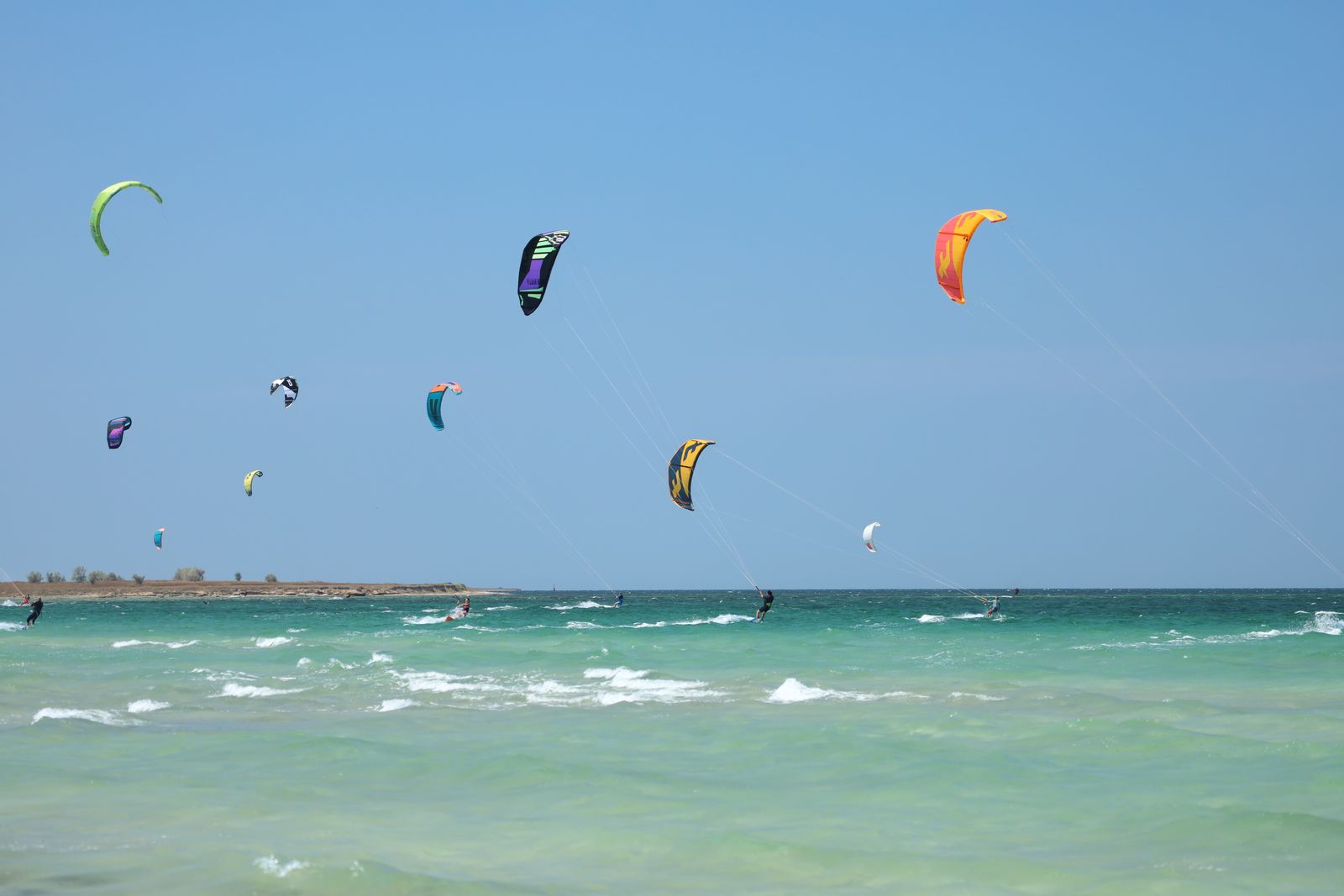
El Gouna's flagship kite beach: a big flat sandy lagoon, standing depth, a very wide standing strip, and nearly all the town's schools (KBC, Kitepower, RedSeaZone, Duotone…). The central, premium spot, to learn or to link moves.
KITESURF
Kitesurfing in Hurghada & the Red Sea: every spot, and which ones are working right now
The Red Sea is the sure bet of the European winter: around 300 windy days a year, warm water even in December, and a cluster of flat sandy lagoons set between desert and reef, around Hurghada and El Gouna. A north to north-west thermal wind, side/cross-onshore, that builds in the afternoon as the desert heats up. Most spots share the same recipe: waist-deep water to learn and freestyle, choppier water offshore for advanced riders. Tide is negligible here; what matters is the day's wind and your level. Every spot below is rated in real time by KiteReady — wind, direction — and ranked from most to least rideable, right now.
Live
Which spots are working right now?
Ranked by live score · pick your level
- 1Safagaflat waterMar – Nov12ktNNOGO
- 2Soma Bayflat waterMar – Nov14ktNNOGO
- 3Sahl HasheeshchopApr – Oct11ktNOBORDERLINE
- 4Makadi Bayflat waterApr – Oct11ktNOBORDERLINE
- 5El Gouna — Mangroovyflat waterApr – Oct9ktNONOT RECOMMENDED
- 6Hurghada — Al Ahyaaflat waterApr – Oct9ktNONOT RECOMMENDED
- 7Hurghada — Magawishflat waterApr – Oct9ktNONOT RECOMMENDED
- 8Seahorse Bayflat waterApr – Oct9ktNONOT RECOMMENDED
01How to pick your spot
Four questions are enough to know whether a Red Sea spot suits you on a given day:
- Your level
- Most spots have a waist-deep flat lagoon to learn AND deeper water offshore for advanced riders. The thermal builds in the afternoon: gentle in the morning, punchier once the desert has heated up.
- The water
- Flat sandy lagoon = ideal for beginners and freestyle (El Gouna, Al Ahyaa, Seahorse Bay, Soma Bay). Offshore sandbar = Caribbean-style flat (Magawish). Watch for coral near shore in some bays (Sahl Hasheesh): booties.
- Wind direction
- The prevailing wind is north to north-west, side/cross-onshore on these east-facing beaches: it brings you back to shore. In front of the buildings of some bays (Makadi) it breaks up — schools then take you out by boat, where it turns clean again.
- The season
- Wind blows much of the year, peaking April to October (about 80% kiteable days in summer). Winter still works — lighter, water around 22 °C, a 4/3 wetsuit — unlike the Mediterranean, which goes to sleep.
KiteReady folds wind and its direction into every spot's score, recomputed continuously, and adapts it to your level.
02Hurghada & El Gouna — the lagoon cluster
The heart of Red Sea kiting: along some sixty kilometres of coast, a string of flat sandy lagoons, from El Gouna's big premium water to the resort bays south of Hurghada. Each spot has its ecosystem of schools, its shallow water to learn and its livelier corner to progress.
The quiet lagoon between Hurghada and El Gouna: a large shallow stretch, soft sandy bottom, a human-scale VDWS club, and room enough to keep beginners and advanced riders apart. A giant pool for a first camp, with a deeper pool offshore for stronger days.
The vast flat lagoon of north Hurghada, and probably the town's densest school hub (Paradise Kitesurf, Masters Surf, Kite School Egypt…). Shallow sandy water to learn and freestyle, livelier offshore.
The cleanest wind in Hurghada, south of town: an offshore sandbar knocks down the swell and lays a vast Caribbean-style flat. A low, reef-free school bay on one side, deeper water with a downwind reef on the other for advanced riders. Booties near the coral.
A large hotel bay south of Hurghada: a mirror-flat lagoon near shore, light chop as you head out. The setting is earned — coral heads guard the entry and the seabed near shore, booties advised. Schools on the bay (Sultan, Kite School Hurghada).
A resort bay south of Hurghada where the real playground isn't in front of the hotels (gusty because of the buildings) but a waist-deep flat lagoon offshore, reached by boat shuttle (near Abu Hashish). A giant pool to learn in peace.
03Soma Bay & Safaga — the big southern flats
Some forty kilometres south of Hurghada, the wind often gains in steadiness and strength. Two resort peninsulas set on vast flat lagoons: the meeting point for flat-water and freestyle fans, a notch windier than the north.
The Ras Abu Soma peninsula: a vast flat lagoon and a sandbar reaching into turquoise water, in front of the big resorts (Kempinski, Sheraton, Robinson). Knee-to-waist deep inside for all levels, often more wind than up north.
The Shams / Abu Soma cluster, the region's historic windsurf and kite base: flat along the beach for all levels, waves further out for advanced riders. Often among the windiest spots in the area.
04Red Sea kitesurfing by level
- Beginner
- The flat sandy lagoons — Seahorse Bay, El Gouna (Mangroovy), Al Ahyaa, Makadi (the boat-accessed lagoon), Soma Bay. Waist-deep water, schools everywhere.
- Intermediate
- Flat plus chop and a bit more wind — Safaga, Sahl Hasheesh (mind the coral at the entry), and the outer parts of the big lagoons.
- Advanced / freeride
- Magawish (sandbar + downwind reef), the deep zones in front of the centres, and the waves off Safaga.
05North or south?
- El Gouna & Hurghada (north)
- The most choice: premium El Gouna, Al Ahyaa and its school hub, Magawish for freeride, quiet Seahorse Bay. Ideal for a first trip, with life around (El Gouna).
- Soma Bay & Safaga (south)
- Often windier and steadier, vast flat lagoons, a calmer resort feel. To maximise wind days and flat water, at the cost of being a bit further from the airport (~55 km).
In short: first trip, variety and life around → the north (El Gouna/Hurghada). Wind-and-flat hunter → the south (Soma/Safaga). Each spot's live score tells you which one is best today.
06When to go to the Red Sea — the wind calendar
- Spring (Mar–May)
- The thermal settles in and gains regularity, the water warms up (shorty), fewer people and softer prices than summer. A nice window.
- Summer (June–Aug)
- Peak season: the steadiest wind (about 80% kiteable days), 15-25 knots from N/NNW, warm water (~29 °C). The trade-off: desert heat, busier spots and higher prices.
- Autumn (Sept–Oct)
- Often the best compromise: still plenty of wind, the warmest water of the year, fewer people and prices easing after summer.
- Winter (Nov–Feb)
- Still rideable — the Red Sea's big advantage: sun, low prices, fewer crowds. The wind is lighter and more fickle, the water drops to ~22 °C: pack a 4/3 wetsuit. The refuge destination of the European winter.
07Planning your trip from Europe
- Getting there (direct flights)
- From Belgium, a direct flight Brussels (BRU) → Hurghada (HRG) on Brussels Airlines and TUI fly year-round, and on Corendon in summer only — its route stops in early November, so don't count on it in winter. From France: Paris-Orly with Transavia, six flights a week across both seasons, and Paris-CDG with easyJet, plus Air Cairo in winter. From the Netherlands: Amsterdam is best served, with Corendon, easyJet, Transavia and TUI fly year-round. Reckon 4 h 50 to 5 h 30 of flight time depending on the airline. On price, mid-week (Tue/Wed) is usually cheaper than the weekend — but with 2-3 charter rotations a week, the cheapest day is often just the day the flight runs. For the exact current price, use the flight link on each spot page — it pre-fills from your departure airport.
- The kite bag
- The catch to know: on the direct charters (TUI fly, Corendon, Brussels Airlines), a kite/board bag is sports equipment charged SEPARATELY — the included 23 kg does NOT cover it, even if the bag is under 23 kg (it's the bag's size, not its weight, that puts it outside the free allowance). Book it WITH the ticket (cheaper than at the airport, where it can even be refused for lack of hold space). Ballpark per leg: Corendon €70 to Egypt (up to 30 kg — kitesurfing has its own fare line there), Transavia €52 out of the Netherlands and €60 out of France (32 kg, up to 3.60 m), TUI fly around €55 (30 kg), Brussels Airlines €100 (up to 200 cm) — so €100 to €200 round trip. At Brussels Airlines the charge mainly hits Light and Basic fares: with a ticket that already includes a checked bag, the equipment can go inside the allowance. A 160 cm bag passes everywhere, so weight and price decide, not length.
- A week's budget
- Per person, ballpark: with your own gear and a simple hotel, ~€750-900 (flight + hotel + meals); renting gear at a 3★, ~€1,350-1,500; all-inclusive with lessons, ~€1,800-2,500. Rental ~€50-110/day, lessons ~€25-35/hr.
- Visa & formalities
- EU citizens need a visa, $30 for a single entry and a one-month stay. Two routes: the visa on arrival, issued around the clock at the desks in Hurghada airport and paid in cash in dollars or euros, which the French authorities actually consider preferable; or the e-visa online, to be applied for at least seven days before departure. On passports, Egypt requires six months of validity from arrival, but the French rule is stricter: six months beyond your return date. The special Sinai regime does not apply here, it only covers an arrival at Sharm el-Sheikh.
- On the ground (transfers, budget, gear)
- Airport transfer ~€20-25, taxis via Uber/Careem (~€2-3 in town, no haggling), local meal ~€3-4, SIM/eSIM ~$12 for ~30 GB, water ~€0.15. Gear storage, pumping, showers and rinsing: through each spot's schools/stations (see the spot pages).
- The wetsuit
- Warm water April to October (~24-29 °C): a shorty or rash vest is enough. In winter (Dec-Feb), water drops toward 22 °C: a 4/3 is a must, booties optional.
- Health & insurance
- Two things not to take lightly. Insurance first: the French authorities warn that without cover for medical costs and repatriation, care can be refused, including in a life-threatening emergency, and the embassy will pay for nothing. The European health insurance card does not work here. Coral cuts next: the surface toxins infect even a shallow wound that looks clean, and they need proper medical follow-up. Otherwise, tap water isn't drinkable, skip raw vegetables, ice cubes and cold buffets, hepatitis A is recommended, and malaria is gone — the WHO certified Egypt malaria-free in October 2024.
Getting to the Red Sea from Europe to kite is simple and affordable — as long as you sort a few practical points guides forget: direct flights, the kite bag (often an extra), the real budget and the visa.
The rest — which spot, which schools, which lodging at the water's edge — is detailed on each spot page above, with the live score.
08Beyond the kite — the no-wind days
The Red Sea is one of the few kite destinations where a windless day is almost worth the trip on its own. By theme.
- Underwater
- This is the first reason to put the kite down for a day. Without a licence, snorkelling works at Giftun and Mahmya, at Shaab El Erg where the dolphins pass, and above all from the shore at Makadi Bay, which has the best swim-accessible reef in the whole area, six metres deep at the drop-off. At Sahl Hasheesh, the Sunken City, a mock pharaonic city submerged between two and six metres, is snorkelling territory. With a licence, the Abu Nuhas wrecks and the walls of Careless Reef and Panorama open up. A boat day with two guided dives runs about €50, €35 as a non-diving passenger, plus €5 to €6 of park fee at Giftun, in cash. The Salem Express off Safaga is a case apart: this ferry sank in 1991 with 470 dead, penetration is forbidden, and you go down as you would enter a memorial. And if you dive, leave 12 h before flying, 18 h after several dives.
- El Gouna & Hurghada
- El Gouna is covered by tuk-tuk or shuttle boat: five minutes from Downtown to Zaytouna island, the town's only shore snorkelling, and a roughly four-hour trip along Abu Tig Marina and the New Marina. Two 18-hole golf courses, one designed by Gene Bates and Fred Couples. In Hurghada, the El Dahar quarter and its souk are the counterpoint to the marina, with haggling compulsory and tourist prices taken as read. The Hurghada museum, opened in 2020, shows two thousand pieces from ancient to modern Egypt for 300 Egyptian pounds, about €5, from 10 am to 1 pm and 5 pm to 11 pm. The Grand Aquarium opens 9 am to 11 pm, around $30 to $33.
- Luxor, as a day trip
- About 290 km and four hours of road each way, doable in a day but at the cost of a 4 am start and a 9 pm return. The classic programme strings together Karnak, the temple of Hatshepsut, the Colossi of Memnon and the Valley of the Kings. Reckon $40 to $70 for a group trip, entries included. One detail that catches people out: Egypt's archaeological sites have moved to card payment only, cash is no longer accepted at the ticket office.
- The desert
- The quad bikes and the 'Bedouin village' are an industrial product: up to sixty quads at once and a village largely staged. Go for the star-filled sky, which is genuinely what everyone remembers, and get what's included spelled out in writing. Far more interesting: the Roman quarries. Mons Porphyrites, whose purple porphyry supplied the imperial columns, and Mons Claudianus, whose granite went into the Colosseum and the Pantheon, can be visited by 4x4 as a day trip from Hurghada. One safety rule to respect: the French authorities formally advise against leaving the main roads and marked tracks, and against driving at night outside tourist areas. The desert yes, but with an operator.
- Soma Bay & Safaga
- Soma Bay has the golf course designed by Gary Player, 18 holes opened in 1998, and a thalassotherapy centre of over 7,500 m² whose centrepiece is a 750 m² hydrotherapy pool filled with seawater. Safaga trades on its reputation for climatotherapy: black sand baths and heliotherapy for psoriasis and rheumatism, in supervised courses of about a month. The success rates put forward come from the destination's promoters, not from independent clinical trials — take them for what they are.
09Frequently asked questions
When is the best time to kitesurf in Hurghada / Egypt?
Peak season runs April to October, with the steadiest wind in summer (June-August, about 80% kiteable days). Autumn (Sept-Oct) is often the best compromise: still plenty of wind, the warmest water, fewer people and easing prices.
Can you kitesurf in Egypt in November or winter?
Yes — that's actually the Red Sea's advantage: it stays rideable in winter, with sun, low prices and fewer crowds. The wind is lighter and more fickle, and the water drops toward 22 °C: pack a 4/3 wetsuit.
Hurghada or El Gouna: which to choose?
El Gouna (Mangroovy) is a big premium flat lagoon with all the schools; Hurghada offers more spots and variety (Al Ahyaa, Magawish, Seahorse Bay). To maximise wind and flat water, also look south (Soma Bay, Safaga), often windier. Each spot's live score settles it day by day.
Which spot to learn kitesurfing in Egypt?
Aim for the waist-deep flat lagoons: Seahorse Bay, El Gouna (Mangroovy), Al Ahyaa, the Makadi lagoon (reached by boat) and Soma Bay. All have schools and shallow sandy water, ideal for a first camp.
Do you need a rescue boat to kite the Red Sea, and what does it cost?
It depends on the spot — and it's a real budget line if you ride independently. Down south (Soma Bay, Safaga) the wind often blows offshore, especially in the morning, over a lagoon that ends at the reef: if you can't ride upwind, you get pushed out to sea. So the schools there impose a compulsory 'safety boat' fee — whether you take lessons OR bring your own gear: you pay it to access the beach and ride under cover. Budget it on top of rental (~€50-110/day); the amount varies by school (often included in a lesson package: Hawa Safaga guide prices, beginner ~€165-595, private ~€55-75/hr). Up north (El Gouna/Mangroovy, Hurghada, Al Ahyaa) the wind comes off the sea and the water is shallow: you always drift back in, no boat needed. In short: to ride freely with no boat fee, head north; Soma Bay/Safaga bring more wind and flat water, but with that extra cost.
How much does a week of kitesurfing in Egypt cost (flight + hotel + gear)?
Per person: with your own gear and a simple hotel, about €750-900; renting gear at a 3★, about €1,350-1,500; all-inclusive with lessons, €1,800-2,500. Rental runs about €50-110/day and lessons €25-35/hr.
How much does it cost to fly with a kite bag?
On the direct charters (TUI fly, Corendon, Brussels Airlines), it's sports equipment charged separately: the included 23 kg doesn't cover it, even if the bag is under 23 kg (it's size, not weight, that puts it outside the free allowance). Book it with the ticket. Reckon €70 a leg to Egypt on Corendon (up to 30 kg), €52 to €60 on Transavia depending on the market (32 kg), about €55 on TUI fly (30 kg) and €100 on Brussels Airlines (max 200 cm) — so €100 to €200 round trip.
Are there direct Brussels-Hurghada flights, and how long?
Yes: Brussels (BRU) → Hurghada (HRG) non-stop, on Brussels Airlines and TUI fly year-round, and on Corendon in summer only — its route stops in early November. Reckon 4 h 50 to 5 h 30 depending on the airline. From France, non-stop from Paris-Orly with Transavia and from Paris-CDG with easyJet; from the Netherlands, Amsterdam is best served, with four airlines across both seasons.
Do you need a visa for Egypt and how much is it?
Yes, $30 for a single entry and a 30-day stay. The visa on arrival is issued around the clock at the Hurghada desks, in cash (dollars or euros), and the French authorities consider it preferable. The e-visa exists too, but it must be applied for at least seven days before departure, not three. Passport valid six months beyond your return date.
Where to eat and buy groceries in Hurghada and El Gouna?
El Gouna is a proper little town: Abu Tig Marina lines up dozens of restaurants and cafés, and Downtown (Kafr El Gouna) has its supermarkets, markets and fast food. At the Mangroovy kite beach, a beach café and a residence mini-market get you by; for a real grocery run, it's Downtown or the marina. Many kiters actually take a self-catering apartment near the beach — you kite all day, an all-inclusive board goes to waste — and shop themselves. In Hurghada, resorts tend to be all-inclusive or half-board; for an apartment (Al Ahyaa, compounds), the supermarkets are at Senzo Mall (Spinneys), in Sakkala, or the BestWay / Carrefour chains.
What is there to do in Egypt on windless days?
The Red Sea first: snorkelling without a licence at Giftun, Mahmya or Shaab El Erg, and from the shore at Makadi Bay, the best swim-accessible reef in the area; with a licence, the Abu Nuhas wrecks and the walls of Careless Reef. A boat day with two dives runs about €50. On land: the Hurghada museum and the El Dahar souk, El Gouna's golf and canals, a day in Luxor (290 km, dawn start) or the Roman quarries of Mons Porphyrites by 4x4. If you dive, leave 12 h before flying, 18 h after several dives.