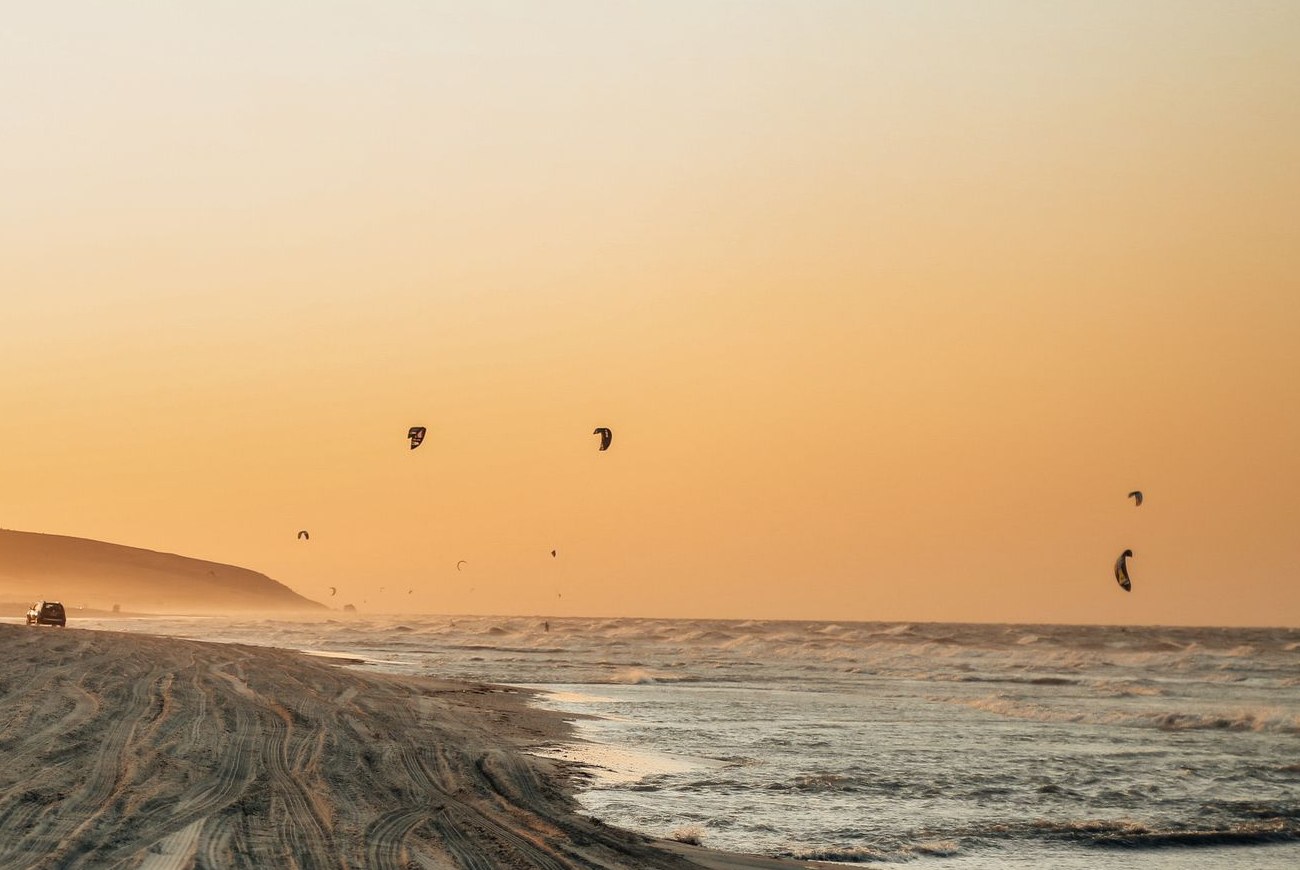
Brazil's entry spot: ~30 km from Fortaleza airport, Cumbuco is a pure, lively, well-equipped kite village, where you rig on a big choppy ocean beach swept by a steady side-onshore wind. Its trump card is right next door: the Lagoa do Cauípe, a huge flat lagoon to learn and freestyle in shelter. Schools, buggies, pousadas, nightlife: Cumbuco is the perfect base camp for a first Brazil kite trip.
KITESURF
Kitesurfing in Brazil: every Northeast spot, and which ones are working right now
Brazil's Northeast is every kiter's dream: a South-East trade wind that blows almost every day from July to January, water at 27 °C you ride in a rash vest, and hundreds of kilometres of beaches and flat lagoons linked by dunes. You kite in steady side-shore, 15 to 30 knots, under the sun, hopping from spot to spot by buggy along the coast. The heart of it is Ceará — from Cumbuco and its Cauípe lagoon to Jericoacoara, the oasis in the dunes, by way of Taíba, Paracuru, Icaraí and Ilha do Guajiru. Around it the coast stretches on: Barra Grande in Piauí, São Miguel do Gostoso in Rio Grande do Norte, and far to the west the Lençóis Maranhenses, a desert of dunes and lagoons where the longest downwinders on earth are run. This is THE destination for downwind and flat water, cut for fast progress and riding without limits. This guide doesn't just tell you where to kite in Brazil: it ranks every spot in real time for your level — wind, direction, tide — from most to least rideable, right now.
Live
Which spots are working right now?
Ranked by live score · pick your level
- 1Brésil — Parajuruflat waterJul – Nov17ktEBORDERLINE
- 2Brésil — Pontal de Maceióflat waterJul – Dec17ktEBORDERLINE
- 3Brésil — Icaraí de Amontadaflat waterJul – Nov16ktEBORDERLINE
- 4Brésil — FlecheirasmixedJul – Dec14ktEBORDERLINE
- 5Brésil — Taibaflat waterJul – Nov13ktEBORDERLINE
- 6Brésil — Fortaleza Futuro BeachchopJul – Dec13ktEBORDERLINE
- 7Brésil — Galinhosflat waterAug – Dec11ktESENOT RECOMMENDED
- 8Brésil — JericoacoaramixedJul – Nov12ktENOT RECOMMENDED
- 9Brésil — Barra Grande do Piauíflat waterJul – Dec10ktENOT RECOMMENDED
- 10Brésil — São Miguel do GostosochopJan – Dec11ktSENOT RECOMMENDED
- 11Brésil — GuriúmixedJul – Dec11ktENOT RECOMMENDED
- 12Brésil — Ilha do Guajiruflat waterJul – Dec12ktENOT RECOMMENDED
- 13Brésil — Atinsflat waterJul – Dec10ktENENOT RECOMMENDED
- 14Brésil — CamocimmixedJul – Dec7ktENOT RECOMMENDED
- 15Brésil — Cumbucoflat waterJul – Dec12ktENOT RECOMMENDED
- 16Brésil — Lagoa do Cauípeflat waterJul – Dec10ktENOT RECOMMENDED
- 17Brésil — Lagoa do Paraíso (Jijoca)flat waterJul – Nov11ktENOT RECOMMENDED
- 18Brésil — Lagoa do Uruaúflat waterJul – Dec12ktENOT RECOMMENDED
- 19Brésil — ParacurumixedJul – Dec11ktENOT RECOMMENDED
- 20Brésil — PreámixedJul – Dec11ktENOT RECOMMENDED
- 21Brésil — Tatajubaflat waterJul – Dec8ktENOT RECOMMENDED
01How to pick your spot
Four questions are enough to know whether a Brazilian spot suits you on a given day:
- Your level
- Brazil is a paradise to learn and progress fast: the flat lagoons (Cauípe, Ilha do Guajiru, Lagoa do Paraíso) offer waist-deep water and steady wind, with schools everywhere. Advanced riders get the ocean and its waves (Préa, Taíba, Jericoacoara) and above all the downwinders, the country's signature. Almost every spot pairs a calm lagoon with an ocean beach a few buggy minutes away.
- The water
- Flat, shallow lagoon (Cauípe, Guajiru, Paraíso, the Taíba lagoon) = ideal to learn and to freestyle. Ocean beach with chop and small waves (Cumbuco, Paracuru, Gostoso) = versatile. Proper waves (Préa, Taíba on the sea side, Jericoacoara) = for those who handle swell. Tide matters: at low tide many lagoons drain and the ocean uncovers sandbanks.
- Wind direction
- The trade wind comes from the East/South-East and, because the Northeast coast runs east to west, it blows side-shore almost everywhere, often side-onshore: the safest set-up, which brings you back to shore. That's what makes the country so welcoming. Do watch downwinders, though: you set off with the wind behind you and don't ride back — always with a buggy or a boat following.
- When to go
- The season runs July to January, with the strongest, steadiest wind from September to December — the southern autumn-into-spring, in full sun. From February to June it's the rainy season and the wind eases: low season. The water, though, stays around 26-28 °C all year. Mind the tide: it sets the rhythm of access to many lagoons.
KiteReady folds wind, its direction and tide into every spot's score, recomputed continuously.
02Ceará — the heart of world kiting
If kiting had a capital, it would be Ceará. Around Fortaleza (FOR), its gateway, the planet's densest string of spots lines up from west to east: the Cauípe learning lagoon, the beach-villages of Cumbuco, Taíba and Paracuru, then the flat-water gems of Icaraí de Amontada and Ilha do Guajiru. The wind blows side-onshore, steady, from July to January, and everything links up by buggy along the sand. Beginner or advanced, you'll find a lagoon to learn on and a beach to let loose, often minutes apart.
Ceará's most famous lagoon, minutes from Cumbuco: flat, shallow, turquoise water, with a wind that builds in the afternoon and brings you back to shore. It's THE learning and freestyle ground par excellence, a mirror to lay down your first tacks stress-free. You reach it by buggy; in the afternoon the lagoon fills with kites and beach bars. A must, whatever your level.
A quieter, more authentic village than Cumbuco, ~70 km from Fortaleza, with two playgrounds: a wave-fed ocean beach, known for strapless and surf-kite, and its own flat, sheltered lagoon (Lagoa da Taíba) for calmer days. The wind is clean and steady, the kite scene sharp but crowd-free. Taíba is the Ceará of riders who want the wave and the flat water in one place, away from the bustle.
A real little fishing-and-surf town ~90 km from Fortaleza, long a competition host: a headland offering both a versatile ocean beach and more sheltered corners, with a steady side-onshore wind. Less of a 'kite village' than Cumbuco, livelier year-round, Paracuru suits those who want to kite by day and find an authentic Brazilian vibe at night. A good all-level compromise, with schools on site.
Icaraizinho de Amontada, ~230 km from Fortaleza: a coconut-grove village set on one of Ceará's steadiest, prettiest beaches. The water runs flat to choppy with the tide, the wind is among the most reliable on the coast, and it's also the launch point for legendary downwinders toward Guajiru. Far enough to have kept its soul, equipped enough (pousadas, French-Brazilian schools) for a full-comfort stay. A regulars' favourite.
A flat-water gem ~250 km from Fortaleza, prized by freestylers worldwide: an almost tide-free lagoon, mirror-smooth, lined with kite-camps where life runs on the wind. The village is small and 100 % kite-focused — you sleep, eat and rig at the water's edge. It's far, it's calm, and it's one of the country's best progression grounds. Paradise for anyone who wants to stack sessions on butter-flat water.
A quiet coconut-lined beach between Paracuru and Icaraí, softer and more family-friendly than its neighbours: fairly flat water near the shore protected by reefs, steady wind, and lovely pousadas. You come for a peaceful pace, natural low-tide pools and crowd-free sessions. A good intermediate stop on the road of the western Ceará spots.
03Fortaleza and the east coast — lagoons and river mouths
Almost everyone heads west on landing in Fortaleza. To the east the coast is quieter and the logic changes: fewer beach-villages, more inland lagoons and river mouths, where the water goes flat for kilometres. This is the side for riders chasing flat water rather than atmosphere, with a shorter run from the airport and far fewer people on the water.
Fortaleza's city beach, seven to eight kilometres of sand along the town's east flank, lined by the famous row of barracas. The easterly trade hits hard in the dry season and the ocean is wide open: real waves and rip currents, a long way from a lagoon. ⚠️ Kiting is regulated here by municipal decree 13.942: banned on Sundays and public holidays, restricted to two stretches marked by street boundaries, and you must stay at least 100 m beyond the breaking waves. Handy when you only have half a day between flights; not a place to learn.
One of the region's largest lagoons, sitting about a kilometre inland among the dunes. No tide here: the water is flat and shallow near the shore, and turns choppy as you head out. The trade wind blows July to January, around 12 to 25 knots, climbing to 30 between October and December. As on every tide-free lagoon in the Nordeste, the wind is gustier than on the coast — that's the price of flat water.
East of Fortaleza, a village set where the water goes flat and the wind stays constant: from June to January the trade wind settles between 15 and 25 knots. Just to the south-east, the mouth of the Rio Piranji gives the same flat water, with the river-ocean mix smoothing the surface. A learning and freestyle spot, without the crowds of the western beaches.
A fishing village 130 km south of Fortaleza, about 1 h 30 by road, and half an hour from Canoa Quebrada. The spot changes face with the tide: at low tide the sandbanks uncover and form flat-water pools, at high tide they vanish and leave chop and soft 70 cm to 1.20 m waves. Two kilometres from the main beach, reachable by buggy, the 'Barra' is a river mouth offering four square kilometres of completely flat water — that's where you go on big-tide days.
04Jericoacoara & the downwind corridor
West of Ceará the coast turns into a desert of dunes where kiting takes on another dimension. Jericoacoara, a former fishing village ranked among the world's most beautiful beaches, is the jewel: a land's end with no paved roads, reached by 4x4 across the dunes. All around, Préa, Guriú, Tatajuba and Camocim form the planet's most famous downwind corridor — you set off from a beach in the morning, ride tens of kilometres pushed by the trade wind, and a buggy collects your gear at night. This is adventure Brazil, of hidden lagoons and sunsets on the dune.
'Jeri': the legendary oasis in the dunes, ~300 km from Fortaleza (last stretch by 4x4). A village with no cars or asphalt, its sandy lanes, turned cult destination for its unreal setting and the nearby Préa lagoon. You kite on the ocean beach and in the surrounding lagoons, with a powerful wind and a one-of-a-kind backdrop of dunes and sunsets. Jeri is as much a mood as a spot — to be lived at least once.
The big Préa beach, just east of Jericoacoara: the zone's 'serious' kite spot, with a wind among the strongest and steadiest in the Northeast and a huge ocean beach to ride side-shore. This is where the kite-camps cluster and the downwinders set off. Windier and more committing than Jeri, Préa rewards riders who want power and space — while staying minutes from the oasis vibe.
The Lagoa do Paraíso, near Jijoca: a freshwater lagoon of unreal blue, ringed with hammock bars, where you ride on knee-deep flat water. Aptly named: it's a paradise to start out, to freestyle and to photograph. You come from Jeri for a postcard session away from the ocean, when you want guaranteed flat water and a laid-back vibe. Ideal for first steps and big-swell days.
A tiny village west of Jeri, at the mouth of a mangrove-lined river: the classic start (or finish) of the region's downwinders. You ride a wild ocean beach and the river-ocean mix, in a landscape of shifting dunes. Few facilities, lots of nature — Guriú is a stage for self-reliant riders stacking downwind kilometres rather than a stay destination. Do it supervised, with a buggy following.
An isolated fishing village 25 km from Jericoacoara and 20 km south of Camocim, on a river mouth: the water moving in and out carves a shallow, smooth area made for learning and freestyle. Right next door, the Lagoa da Torta is perfectly flat and fills at high tide. The wind is side-onshore with rare consistency — 99 % windy days from July to February, 17 to 23 knots at the heart of the season, sometimes over 30. One caveat: on these tide-free lagoons it is noticeably gustier than on the coast.
The end of the corridor, at the mouth of the Rio Coreaú, close to the Piauí border. Opposite the town, the river delta spreads out perfectly flat water. It's the classic finish of the downwinders: 18 km more by kite from Jeri, or 16 km from Tatajuba. The beach track can be driven this far even without a 4x4, but at high tide you need to know the route and have the experience — otherwise the water traps you.
05Piauí & Rio Grande do Norte
On either side of Ceará, two states keep the party going far from the crowds. To the west, Piauí and its tiny coast hide Barra Grande, a sand village turned cult flat-water spot. To the east, Rio Grande do Norte lines up São Miguel do Gostoso, a laid-back kite town ~100 km from Natal, and wilder corners like Galinhos. Same trade wind, same lagoons, but a more low-key crowd and an end-of-the-road feel — for those who want Brazil's kiting without the most-trodden postcard.
The Northeast's best-kept secret, on Piauí's small coast: a paved-road-free sand village where kiting is king, with a huge flat-water zone at low tide and a wind of insane consistency from July to December. Downwind, barefoot, hammock vibe, accredited schools and pousadas at the water's edge. More off-the-map and less busy than Ceará, reached via Fortaleza (~6 h drive) or a hop to Parnaíba. A real flat-water crush.
~100 km north of Natal, at the point where the coast swings from east to north, Gostoso catches the wind from two angles and has two complementary beaches: Maceió, more sheltered and perfect to start on, and the more exposed windsurfers' beach. A former fishing village turned laid-back, cosmopolitan kite town, with good schools and charming pousadas, it's a gentler, more accessible alternative to the far-western spots. The wind blows side-shore, steady, under the Northeast sun.
A fishing village with little infrastructure, 165 km north of Natal, set on a peninsula that is really just a long sandbar: the Atlantic on one side, the mouth of the Rio Aratuá on the other. The contrast from one edge to the other is sharp — on the mangrove side the water is shallow and butter-smooth, near the lighthouse it chops up. The local trade wind, the 'Leste', gives 15 to 25 knots, with the best window from August to February. The water never drops below 27 °C and the beaches stay empty.
06Maranhão — the Lençóis
At the far west of the kiting Northeast, Maranhão opens onto another world: the Lençóis Maranhenses, a vast desert of white dunes dotted with turquoise rainwater lagoons, unique on earth. At its edge, the village of Atins, at the mouth of the Preguiças river, is the gateway to pure adventure kiting — the flat water of the lagoons, the wild ocean, and above all the multi-day downwinders across the national park. You come for the expedition as much as the wind: it's the end of the road, and every travelling kiter's dream.
The frontier village of the Lençóis Maranhenses, reached by 4x4 and boat from São Luís: no paved road, just sand, donkeys and charming pousadas by a vast beach. You kite on the ocean and on the Preguiças river, but Atins's true signature is the dream downwinders across the national park's dunes and lagoons. For self-reliant, adventurous riders with local guiding — the access is long, the reward immense.
07Kitesurfing in Brazil by level
- Beginner
- Brazil is one of the best places on earth to learn: flat, shallow, warm lagoons, steady side-onshore wind, schools everywhere. Head for Cauípe (Cumbuco), the Lagoa do Paraíso (Jeri), Ilha do Guajiru or Barra Grande. Always with a school, and mind the tide that drains some lagoons.
- Intermediate
- The playground opens up: versatile ocean beaches and first downwinders. Cumbuco, Paracuru, Flecheiras, Gostoso and Icaraí offer chop, a little wave and space to link runs. This is the time to taste the downwind, the country's signature, always with a buggy or a boat following.
- Advanced · expert
- Strong wind, waves and long crossings: Préa and Taíba for power and strapless, Jericoacoara for the setting, Guriú and above all the Lençóis (Atins) for long-haul downwinders. Self-reliance, managing the tide and river-mouth currents, and a support crew following on the downwinders.
08Ceará, Piauí, RN or Maranhão — which region?
- Ceará (Cumbuco → Guajiru)
- The safe bet for a first trip: gateway at Fortaleza, the highest density of spots, schools and pousadas, all linked by buggy. Beginners stay on the Cauípe lagoon at Cumbuco, self-reliant riders push on to the wilder lagoons of Icaraí and Guajiru. If you only pick one region, it's this one.
- Jericoacoara & the corridor
- The vibe + downwind pick. Jeri offers a unique setting (dunes, car-free village) and Préa a muscular wind; all around, the Guriú-Tatajuba-Camocim corridor is the downwinders' playground. Further from the airport (4x4 at the end of the road), more of a change of scene, a notch more adventurous.
- Piauí, RN & Maranhão
- The low-key alternatives. Barra Grande (Piauí) and Gostoso (RN) offer the same wind and flat water with fewer people and a different gateway (Fortaleza/Parnaíba, or Natal). Maranhão and the Lençóis (Atins) are an expedition apart — the ultimate adventure kiting, for self-reliant riders.
In short: a first trip, density and easy logistics → Ceará. The vibe, the dunes and the downwind → Jericoacoara and its corridor. Quiet and adventure → Piauí, Rio Grande do Norte and the Lençóis.
09When to kite in Brazil — the wind calendar
- Peak season (September–December)
- The absolute peak: the South-East trade wind is at its strongest and steadiest, 18-30 knots almost every day, bright sun, water at ~27 °C. This is THE Northeast window — guaranteed wind, schools in full swing, downwinders galore. The busiest stretch, to book early.
- Shoulder season (July–August & January)
- Still excellent conditions and a little fewer people: the trade wind is already (or still) well set, often 15-25 knots. July-August is perfect to escape the European summer, January to close the season in the warmth. A great wind/crowd compromise.
- Low season (February–June)
- The rainy season: the wind eases and turns irregular, especially March to May. Not the time for a dedicated kite trip — better aim for July-January. The water, though, stays warm all year, and the landscape is greener.
- The tide, everywhere
- Beyond the wind, the tide sets the rhythm of the day: many lagoons (Cauípe, Guajiru, Barra Grande) only fill well at certain hours, and the ocean uncovers sandbanks at low tide. On downwinders and river mouths (Guriú, Atins), it also drives the currents. KiteReady folds it into the score.
10Getting there & getting set up
- Getting there (flights)
- Fortaleza is reached non-stop from Paris-CDG with Air France, two flights a week and about 9 h, and from Lisbon with TAP year-round, 7 to 8 h; Iberia also flies in direct from Madrid. From Brussels and Amsterdam there is no direct flight: you connect through Lisbon or Paris. For São Miguel do Gostoso you land at Natal (NAT) instead, which TAP serves non-stop from Lisbon, then 1 h 40 by road. For the Lençóis, aim for São Luís (SLZ), almost always with a Brazilian stopover, then road and boat to Atins.
- On the ground (transfers & buggy)
- From Fortaleza, Cumbuco is 45 minutes away, Taíba and Paracuru 1 h 30, Icaraí and Guajiru 4 h, Jericoacoara 5 h with a final 4x4 stretch through the dunes. Schools and pousadas arrange the transfers, and renting a buggy locally is an institution, around 200 to 280 reais a day. The moment you drive on the beach or toward a lagoon, the tide is in charge: some stretches of sand only pass at low tide.
- The kite bag
- At TAP the bag can go inside your allowance if it stays under 23 kg in economy and 158 cm overall, but a transport declaration form is compulsory, without which it can be refused; beyond that, an extra bag starts around €45 and oversize is quoted case by case. Air France counts boards up to 300 cm and 23 kg as one piece of the allowance, and on long haul they can travel instead of a suitcase: clearance to request from customer service at least 48 h ahead. At KLM, booking is compulsory as soon as the bag exceeds 107 cm, also 48 h ahead, with no surcharge on Brazil.
- Paperwork
- No visa for a tourist stay: 90 days within any 180, a passport valid six months beyond your return, and an onward ticket you may be asked for at boarding. The electronic visa introduced in April 2025 applies only to Americans, Canadians and Australians: French, Belgian and Dutch citizens remain exempt.
- Money & connectivity
- The real runs around 5.75 to 5.90 to the euro. Cards work everywhere in town, but Pix dominates: more than one payment in two nationwide, and some beach kiosks and small vendors take nothing else, a foreigner being able to get on it through an app like Wise. Brazil sits outside the European roaming zone: take a local card, TIM sells on a passport alone and Vivo covers the Northeast coastline best, or an eSIM before you leave.
- A week's budget
- The big item is still the flight, often €700 to €1,000 return depending on the season. On the ground, ballpark per person: €35 to €70 a night in a Cumbuco pousada, €3 to €7 for the dish of the day, about 390 reais for a full day's rental, roughly sixty euros, and around 900 reais for a 10-hour beginner package. The taxi between Fortaleza airport and Cumbuco costs about 130 reais for 45 minutes. That value for money is why trips run two or three weeks: the airfare spreads out.
- Sun, water & health
- The water stays between 26 and 28 °C all year, a rash vest is enough. The real adversary is the sun: the UV index climbs to 12, sometimes 14, and the glare off water and sand doubles the dose. High-factor cream, long-sleeve rash vest, cap. Tap water isn't drinkable, stick to bottles. On vaccines, official advice diverges: some recommends yellow fever for the whole of Brazil, others target only Maranhão and Piauí without listing Ceará, so ask a travel clinic based on your itinerary. Hepatitis A is advised, and dengue is surging, so bring mosquito protection.
Ceará's gateway is Fortaleza (FOR), and contrary to what you often read, there are direct flights from Europe: Air France links Paris-CDG to Fortaleza twice a week in about 9 h, and TAP runs Lisbon-Fortaleza year-round in 7 to 8 h. From Brussels or Amsterdam you need a connection. Start with a school, they're everywhere: Cumbuco, Taíba, Icaraí, Guajiru, Gostoso, Barra Grande, Atins. And for any downwinder, never set off without a buggy or a boat following.
Your kite size depends on wind and your weight: KiteReady suggests it from the conditions, and the live ranking above tells you which spot is working today.
11Beyond the kite — the no-wind days
In season the wind rarely fails, but you do put the kite down for a day, or extend the stay. The region has plenty to fill it.
- Cumbuco & Fortaleza
- The buggy tour through the dunes is the local institution: one to three hours, four passengers, with sandboarding, a zipline and a slide over the Cauípe and Parnamirim lagoons, where you swim without a kite. Forty-five minutes away, Fortaleza is worth a day: the Mercado Central for crafts and tapioca, the Centro Dragão do Mar for its museums and evening bars, and the old centre around the Theatro José de Alencar.
- Jericoacoara
- The Pedra Furada, the stone arch at the water's edge, which the sun sets inside in July and August. The Duna do Pôr do Sol, where the whole village climbs up to watch the sun drop into the sea. The Lagoa do Paraíso with its hammocks planted in turquoise water. And in the evening, forró and capoeira on the sandy square. The village sits inside a national park: an entry fee was announced and then suspended by the courts, so check on arrival.
- Lençóis Maranhenses (Atins)
- The desert lagoons fill after the rains and can be visited from May to September, at their best in June-July: the wind season therefore only overlaps that window in July, August and September. From Atins, 4x4 tours run to the park's lagoons, and Canto do Atins is three kilometres away along the sea. The other classic is the rio Preguiças descent by boat from Barreirinhas, with the monkeys of Vassouras, the Mandacaru lighthouse and the Caburé sandbar.
12Frequently asked questions
What's the best time to kite in Brazil?
July to January, with a wind peak from September to December: the South-East trade wind then blows 18-30 knots almost every day, under the sun, over water at ~27 °C. From February to June it's the rainy season and the wind eases — best avoided for a dedicated trip. In season the Northeast is one of the most reliable destinations on earth.
Which spot to learn kiting in Brazil?
Flat lagoons are perfect to learn: the Lagoa do Cauípe (next to Cumbuco), Ilha do Guajiru, the Lagoa do Paraíso near Jeri, or Barra Grande. Shallow water you can stand in, a steady side-onshore wind that brings you back to shore, and schools everywhere. Cumbuco is the ideal base camp for a first trip: close to the airport, lively, fully equipped.
What's a downwinder, and where to do one in Brazil?
A downwinder means riding from point A to point B with the wind behind you, without riding back: Brazil is its world capital. The most famous start from the Jericoacoara corridor (Préa, Guriú, Tatajuba, Camocim) and above all cross the Lençóis Maranhenses from Atins, over several days. A buggy or a boat follows for gear and safety — you never go alone, and it's for self-reliant riders.
How do you get around between spots in Brazil?
Along the Ceará coast, you link spots by buggy or private transfer (often arranged by schools and pousadas). From Fortaleza: Cumbuco ~45 min, Taíba/Paracuru ~1 h 30, Icaraí/Guajiru ~4 h, Jericoacoara ~5 h with a final 4x4 stretch through the dunes. Some remote spots (Atins in the Lençóis) need road plus boat. Renting a buggy locally is an institution.
Can you explore Brazil on your own, in your own vehicle?
Yes, as long as you grasp that there are two driving worlds. On the road (asphalt and tracks) between the base villages — Cumbuco, Taíba, Paracuru, Icaraí, Guajiru — a passenger car with a bit of ground clearance is enough, and going solo is easy. The moment you drive on the beach or climb toward a lagoon, a 4x4 or buggy becomes mandatory (~R$200-280/day), and there the tide is in charge: some stretches of sand only pass at low tide and you can get trapped by the rising sea. The regulars' habit: rent in Cumbuco rather than Fortaleza, gather local intel a day or two before setting off, and never drive at night (livestock, pedestrians, no lighting). Finally, the genuinely technical bits — the final dune approach to Jeri inside the park, the river crossings toward the Lençóis, and support for any downwinder — are almost always done with a local buggy driver, even when you travel on your own.
Do you need a wetsuit to kite in Brazil?
No. The Northeast water stays around 26-28 °C all year: a rash vest (for the sun and the harness) or at most a shorty is plenty, and many ride bare-chested or in boardshorts. The real hazard is the sun: high-factor cream, a long-sleeve rash vest and a cap under the helmet are real allies, especially on long sessions and downwinders.
Cumbuco or Jericoacoara — which to choose?
Cumbuco is the easy, lively pick: 45 min from the airport, fully equipped, with the Cauípe lagoon to learn on — perfect for a first trip or a short stay. Jericoacoara is the experience: a car-free village in the dunes, ~5 h by road (4x4 at the end), an unreal setting and a muscular wind at nearby Préa. Many do both: a few days in Cumbuco to warm up, then Jeri for the vibe.
Is Brazil expensive for a kite trip?
The big item is the flight from Europe, often €700-1000 return depending on the season. On the ground, though, Brazil stays affordable: charming pousadas, meals and schools are far cheaper than in the Canaries or Egypt, and value for money is excellent. A long stay (2-3 weeks) spreads the airfare all the better — hence the tradition of long-lasting Brazil trips.
Is there a direct flight to Fortaleza from Europe?
Yes. Air France links Paris-CDG to Fortaleza non-stop, two flights a week, in about 9 h, and TAP runs Lisbon-Fortaleza year-round in 7 to 8 h; Iberia flies in from Madrid too. From Brussels and Amsterdam, though, there's no direct flight: you connect through Lisbon or Paris. Natal is served non-stop by TAP from Lisbon, and São Luís, the gateway to the Lençóis, almost always needs a Brazilian stopover.
Do you need a visa for Brazil?
No, not for a tourist stay: 90 days within 180, with a passport valid six months beyond your return and an onward ticket you may be asked for at boarding. The electronic visa brought in during April 2025 targets only Americans, Canadians and Australians: Europeans remain exempt.
How do you fly with kite gear to Brazil?
At TAP the bag can fit inside your allowance under 23 kg in economy and 158 cm, but the transport declaration form is compulsory; beyond that, an extra bag starts around €45. Air France counts boards up to 300 cm and 23 kg as one allowance piece and takes them instead of a suitcase on long haul, with customer-service clearance 48 h ahead. KLM requires a booking from 107 cm, with no surcharge on Brazil.
What is there to do in Brazil on windless days?
Around Cumbuco, the buggy tour through the dunes with sandboarding and a swim in the lagoons, and Fortaleza 45 minutes away for its Mercado Central and the Centro Dragão do Mar. In Jericoacoara, the Pedra Furada, the sunset dune, the Lagoa do Paraíso with its hammocks in the water, forró and capoeira in the evening. In Maranhão the Lençóis lagoons can be visited from May to September, and the rio Preguiças descent leaves from Barreirinhas.