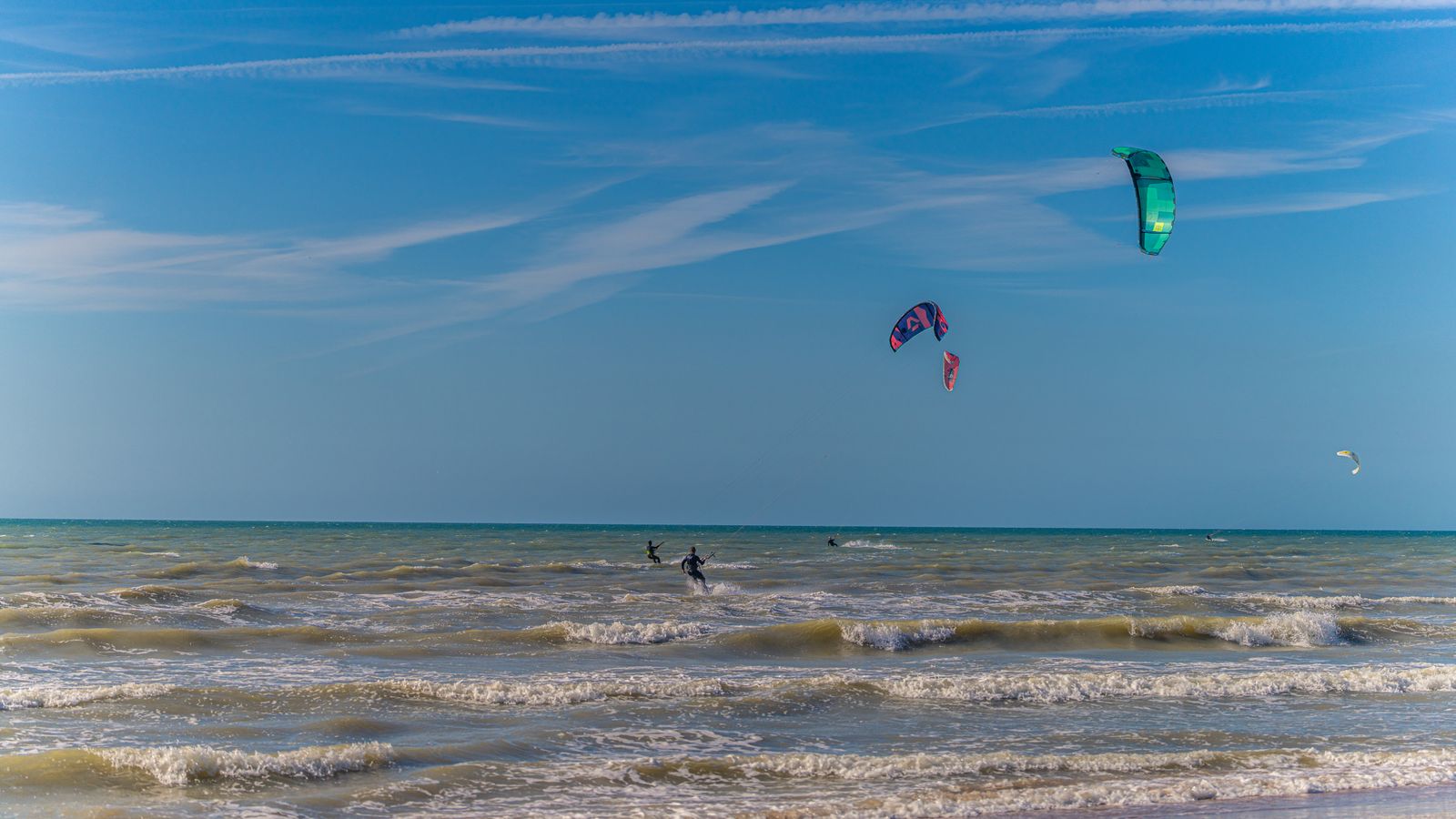
The different types of wind in kitesurfing
Wind isn’t just “there’s some or there isn’t”. There are two big families, a scale to measure it, directions that decide your safety, and a handful of famous winds that give spots their character. Here’s how to read a forecast — and know where it’s blowing, right now.
Two families of wind
Almost every wind you’ll ride belongs to one of these two families. Telling them apart already tells you what to expect on the water.
- The weather windthe “gradient” wind
- The wind of pressure charts, flowing between highs and lows. It can blow hard, from any direction, at any hour — but when a low is active it’s often unstable and gusty.
- The thermal windthe breeze
- A local wind the sun builds: land heats faster than sea, and the air starts to move. Gentler, but steady, clean, and reliably there in the afternoon. The wind of good sessions.
How much wind do you need?
Strength is measured in knots (1 knot ≈ 1.85 km/h), laid out on the Beaufort scale. Here’s what each band means, kite in hand.
One rule holds it together: the more wind, the smaller the kite. Roughly 12 to 15 m² in light wind, 6 to 9 m² when it’s blowing hard (a guide for ~75 kg — your weight and level shift the dial).
Onshore, offshore, side: direction is safety
Direction is the angle of the wind to the beach. It changes everything — not the difficulty, the safety. One rule rules them all: the offshore wind is avoided.
- Onshoretowards land
- Straight in from the sea to the beach. Reassuring (it always brings you back), but it pushes you towards the sand: you need to be able to ride upwind.
- Offshoreout to sea — DANGER
- From the land out to sea. The most dangerous direction: at the smallest failure you drift out with no way back. The IKO is blunt — always avoid it, unless a rescue boat is on the water.
- Sideshoreparallel
- Along the beach. Perfect for long reaching runs — as long as you can ride upwind to get back in.
- Side-onshorethe reference
- Diagonally towards land. The best of both: it clears the sand on take-off and always brings you back. The go-to direction for learning.
The thermal wind: the breeze that fills in after lunch
It’s the kiter’s favourite wind, and it answers to the sun. Understand its cycle and you’ll know when to rig up.
In the morning the sun heats the land far faster than the sea. The air over the land warms, lightens and rises; cool sea air rushes in underneath to take its place — that’s the sea breeze. It builds through late morning, peaks in the early afternoon, then fades in the evening. Météo-France puts it around 15 to 30 km/h, sometimes 50 on the best days. Because it carries cool, stable marine air, it runs smooth and dependable: the wind of easy sessions. At night it all reverses — the land cools, the air drains back out to sea: the land breeze, weak and offshore, best left alone.
Steady, or gusty?
Two winds of the same strength don’t give the same session. What changes is how steady it is.
A gust is churned air: when the atmosphere is unstable, bubbles of air rise and sink and drag bursts of speed down to the surface — the wind turns choppy. Hills, buildings and trees break the wind the same way. The sea breeze, by contrast, glides over cool water in stable air: it stays even. That’s why a thermal 18 knots is far nicer — and safer — than a low-pressure 18 knots that spikes to 28 without warning.
Steady wind = stable air. Gusts = unstable air, or air broken up by terrain.
The wind window, and the Venturi effect
Two last ideas you’ll hear kiters mention all the time.
The wind window is the slice of sky where your kite has power: a quarter-sphere in front of you, facing the wind. At the edge of the window the kite barely pulls; at the centre (the zenith and the power line) it hauls. All of piloting is walking the kite around that window. As for the Venturi effect, it’s what builds the great spots: when air is forced through a narrowing — a strait, a valley — it speeds up. The Strait of Gibraltar supercharges Tarifa’s wind; the Rhône valley launches the Mistral. It’s also why two neighbouring beaches don’t always share the same wind.
The big named winds, and where to ride them
Some winds have a name, a season, a temper — and a spot where they run the show. Here are the five that matter to a European kiter.
- TramontaneNW · Languedoc
- A north-westerly funnelled between the Massif Central and the Pyrenees. Powerful, a touch turbulent, it made Leucate’s name.
- MistralN-NW · Rhône valley
- Cold and strong, accelerated by the Rhône valley (Météo-France calls it a “real” Mistral beyond 32 knots). Often gusty: a wind for confident riders.
- Levante & PonienteE / W · Tarifa
- The two breaths of the Strait of Gibraltar. The Levante (east) is warm, strong and edgy; the Poniente (west) cooler, cleaner and steadier. Tarifa, the “wind machine”.
- MeltemiN · Aegean Sea
- The northerly of the Greek summer, from May to September. Force 5 to 7, reliable for weeks on end: it makes the islands’ kite season.
- Trade windsNE · Morocco, Canaries
- The planet’s tropical winds, steady and faithful. On the Moroccan coast they stack onto the afternoon thermal boost — the secret of Dakhla and Essaouira.
The questions everyone asks
Three that come up at the start of every season.
- What’s the minimum wind to start kitesurfing?
- Around 12 to 15 steady knots, ideally side-onshore. Enough to fly a big kite, not enough to overpower you. Below 11 knots the kite barely pulls.
- Is offshore wind dangerous?
- Yes — it’s the number-one danger in kitesurfing. A wind blowing from land out to sea carries you offshore at the smallest failure, with no power to get back. The IKO recommends always avoiding it, unless a rescue boat is out.
- Thermal wind or weather wind — which is better?
- For an easy ride, the thermal: steadier, cleaner, reliably there in the afternoon. The weather (low-pressure) wind can be stronger but also gustier and less predictable.