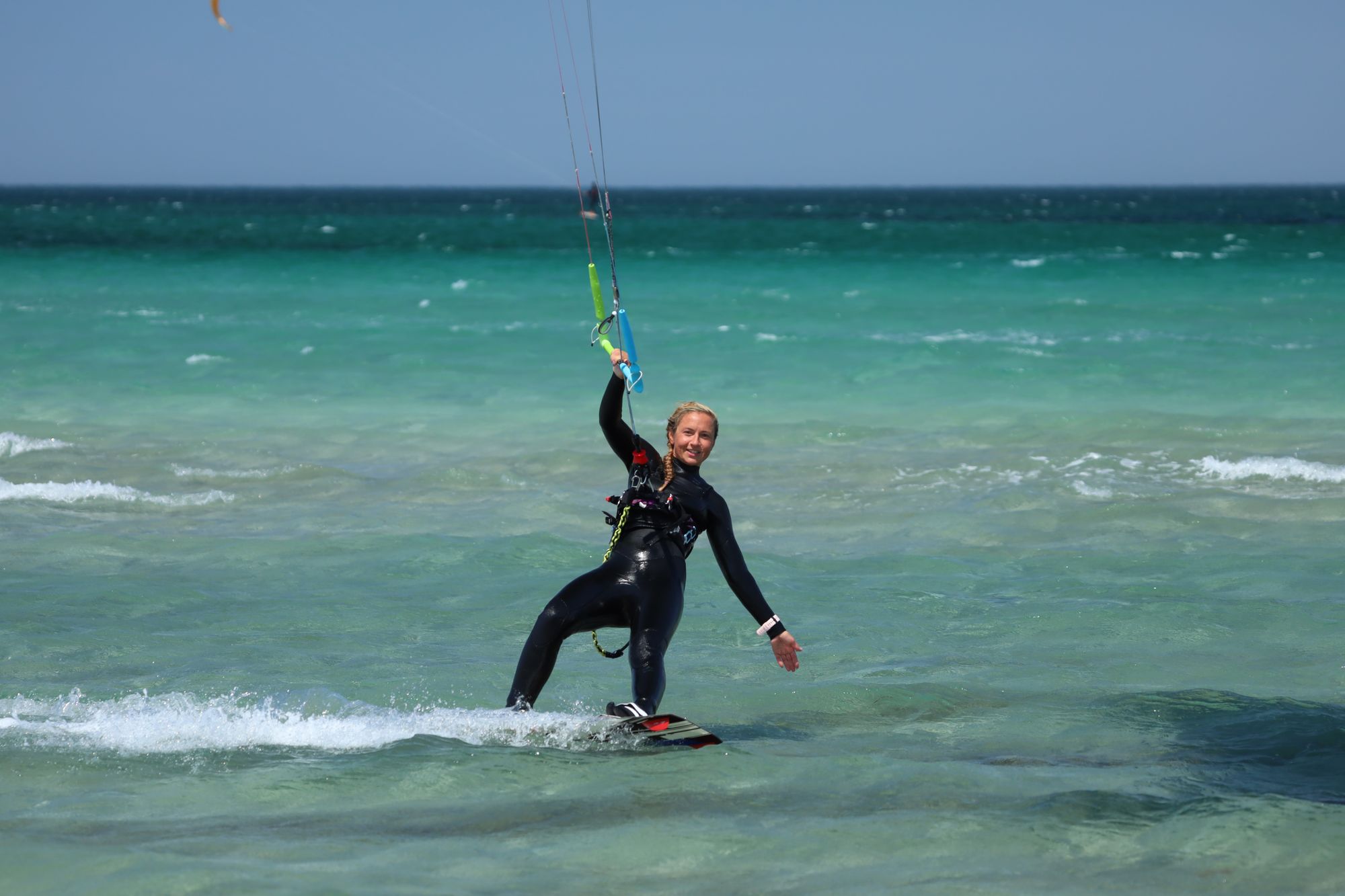
THE Kite Beach, at Cabeça das Salinas on the east coast — the address that made Sal a world kite destination. The trade wind comes in side-onshore and gently nudges you back to the beach: the reassuring set-up par excellence. Inside, a flat, shallow lagoon you can stand in, perfect to start and to progress; further out, a reef throws up small waves to play on. It's the schools' hub (ION Club, Duotone, KBC), the place where you learn and where the whole community meets. Watch for sea urchins on the reef — thin booties are no luxury.
KITESURF
Kitesurfing in Cape Verde: every spot, and which ones are working right now
Set deep in the Atlantic off Senegal, Cape Verde is a string of volcanic islands the trade wind — the North-East “Alísios” — sweeps under nearly 350 days of sun a year, over water that rarely drops below 24 °C. Here you kite in a T-shirt in the middle of the European winter, in a steady 15 to 25 knots. Three islands carry the game: Sal, the kite queen, with the flat lagoon at Kite Beach to learn on and the legendary right-hander of Ponta Preta for experts; Boa Vista, its wilder twin with a longer season; and São Vicente, the island of music and Cesária Évora, more adventurous, reached from Mindelo. It's a destination cut for intermediate, advanced and wave riders — yet beginners find their lagoon here too. This guide doesn't just tell you where to kite in Cape Verde: it ranks every spot in real time for your level — wind, direction, tide — from most to least rideable, right now.
Live
Which spots are working right now?
Ranked by live score · pick your level
- 1Cap Vert — Baía das Gatas (São Vicente)flat waterJan – Dec14ktNNEBORDERLINE
- 2Cap Vert — Kite Beach (Sal)flat waterJan – Dec15ktNEBORDERLINE
- 3Cap Vert — Kite Beach BoavistachopJan – Dec14ktNEBORDERLINE
- 4Cap Vert — Ponta Leme (Sal)mixedJan – Dec15ktNEBORDERLINE
- 5Cap Vert — Ponta Preta (Sal)wavesJan – Dec15ktNEBORDERLINE
- 6Cap Vert — Praia de Chaves (Boavista)mixedJan – Dec14ktNEBORDERLINE
- 7Cap Vert — Salamansa (São Vicente)mixedJan – Dec14ktNNEBORDERLINE
- 8Cap Vert — Santa Maria (Sal)flat waterJan – Dec15ktNEBORDERLINE
- 9Cap Vert — Lagon Sud (Boavista)flat waterJan – Dec14ktNENOT RECOMMENDED
- 10Cap Vert — Ponta do Sinó (Sal)wavesJan – Dec15ktNENOT RECOMMENDED
- 11Cap Vert — São Pedro (São Vicente)flat waterJan – Dec13ktNENOT RECOMMENDED
01How to pick your spot
Four questions are enough to know whether a Cape Verde spot suits you on a given day:
- Your level
- Cape Verde rewards intermediate, advanced and wave riders most. Beginners have two real refuges: the Kite Beach lagoon on Sal and the sheltered Sal Rei bay on Boa Vista. Experts get Ponta Preta and São Pedro. In between, almost every spot has a calm zone and a committing one a few hundred metres apart.
- The water
- Flat, shallow lagoon (Kite Beach on Sal, Sal Rei on Boa Vista, Baía das Gatas on São Vicente) = ideal to learn and to freestyle. Bay chop (Santa Maria, Salamansa) = versatile. Reef and ocean waves (Ponta Preta, Ponta do Sino, Praia de Chaves in winter) = for those who handle swell. Thin booties help near the reefs.
- Wind direction
- The trade wind almost always comes from the North-East, but its angle changes everything from spot to spot. At Kite Beach it's side-onshore and nudges you back to shore — the most reassuring. Elsewhere it tips side-offshore, even offshore: Ponta Preta and Sal's west points, Boa Vista's south lagoon, São Pedro. There it takes you out to sea and a current can set in — never ride those without a school or a rescue boat.
- When to go
- The main season runs November to May, peaking January to March on Sal. Boa Vista and São Vicente also catch a South-West/North-North-East flow in summer, stretching their season toward June-August. From July to October the wind eases everywhere: it's the low season. Tide matters little (a small Atlantic range), but an offshore current can add to it on the west points.
KiteReady folds wind, its direction and tide into every spot's score, recomputed continuously.
02Sal — the kite queen island
A low, ochre, lunar island fringed with white beaches — and the beating heart of Cape Verde kiting. This is where the direct flights from Europe land (SID, ~6 h 50), where the schools cluster, where you find it all: the Kite Beach learning lagoon, the Santa Maria base bay and the world-class right-hander of Ponta Preta. The North-East trade wind blows from deep winter into spring, peaking January to March. Everything is a taxi or buggy ride from Santa Maria — you pick your spot of the day by your level and the wind's angle.
Sal's global star: a long, powerful reef right-hander (3 to 6 m on the big days) that peels to perfection, a GKA World Cup venue and Mitu Monteiro's home wave. The wind blows cross-offshore — it smooths the face but pushes you seaward, and a current drags you out. Strictly for experts at ease in waves and self-rescue: this is neither a place to learn nor a place to get it wrong. You come to watch it from the cliff first, before you ride it.
The town bay, with its fishermen's pier and its lively sand: this is Cape Verde's base camp, where nearly everyone sleeps, eats and meets after the session. The water runs from flat to choppy, with a side-offshore wind — the closer it skims the buildings, the gustier and more ragged it gets. Handy for a session at the foot of your hotel, but not the island's steadiest spot: for riders who can hold upwind. Rig well away from bathers and the pier.
The east point of Santa Maria bay, away from the crowd: the wind arrives cross-offshore, the water is flat on the inside, and a left-hander rises on swell for those who want a taste of the wave without Ponta Preta's commitment. The ION Club Ponta Leme centre runs coaching and pick-ups here — a real plus, because the offshore angle means you must hold upwind. A solid step up from Kite Beach, ideal for moving from flat water to the wave.
The island's south point, marked by its lighthouse: a point break that breaks over rocks, swept by a cross-offshore wind. The reward is a clean wave to ride far from the crowd; the price is a rocky bottom and an angle that pushes you seaward. For riders at ease in waves and self-reliant — thin booties recommended, and never alone when the wind blows offshore.
03Boa Vista — the wild twin
Bigger, more desert-like and less tamed than Sal, Boa Vista lines up dunes blown in from the Sahara, beaches as far as the eye can see, and a handful of large resorts dropped into the emptiness. It's Cape Verde's second kite island, also linked to Europe by direct flights (BVC, ~7 h). Its edge: on top of the winter trade wind, it catches a South-West flow in summer, stretching its season well beyond Sal's. The hub is Sal Rei and its lagoon sheltered by an islet; the rest is earned by 4x4. A notch more adventurous, a notch emptier.
Sal Rei's “Kite Beach”, at Praia de Carlota: flat water, sheltered from the swell by the Sal Rei islet sitting just offshore, and the island's school hub (Matchu Lopes' Duotone Pro Center, Kitekriol). The North-East trade wind comes in side-offshore and a touch gusty — hence the value of coaching — but the flat water and the islet's shelter make it an excellent ground to learn and to link tricks. Boa Vista's meeting point, a stone's throw from town.
A vast wild beach on the west coast, near the airport and the big resorts (VOI, Riu, Occidental): kilometres of open sand where space is never short. On the inside the water is flat enough to start on in an onshore wind; in winter a beach-break rises and gives you waves to play in. Wind and swell are more full-on here than at Sal Rei — a fine progression ground running from your first tack to the wave, depending on where and when you rig.
A flat, shallow, isolated lagoon at the very south of the island, near the Riu Touareg: on paper a beginner's paradise — glassy, calf-deep water. But there's a trap: the wind here often blows offshore, pushing you out to sea. So it's a spot to ride with a school and its support (the Surf Vista station operates here), never alone. The setting is stunning and the water perfect; safety, though, runs strictly through the coaching.
04São Vicente — the island of Mindelo
Here you leave the Cape Verde of resorts for the Cape Verde of culture. São Vicente is Mindelo, its musical capital, its cafés and the memory of Cesária Évora — a mountainous, vibrant island, more adventurous than beach-resort. There's no direct flight from Europe: you go via Lisbon, or via Sal and an inter-island hop. Kiting here is more low-key, carried by a small local scene rather than big centres — but it holds a gem: Baía das Gatas, the only true permanent flat-water lagoon in the whole archipelago. For those who want the culture as much as the wind.
The island's jewel, and a rarity on the Cape Verde scale: the ONLY permanent flat-water lagoon in the archipelago, shielded from the ocean by a barrier of rocks. Water smooth as a mirror, a dream for freestyle and pure gliding. The best time is the morning, when the wind is clean and the sea low; later, tide and rocks complicate the entry. An intermediate-to-advanced spot, best savoured early, before the day builds.
São Vicente's teaching beach, on the north coast: the North-East trade wind arrives cross-onshore, usually 16 to 27 knots, with a sheltered zone near the shore for beginners and waves further out for everyone else. It's the island's most accessible, most versatile spot, run by a small local outfit based at the Chez Zoe crêperie. None of Sal's big centres, but the essentials are here — and a wind that brings you back to shore.
A gorgeous bay near the airport, where the wind funnels into a side-offshore corridor and turns it into a flat-water speed spot — beautiful, but treacherous. São Pedro's quirk: kiting here is regulated, allowed only with an operator and a rescue boat. The offshore angle and the corridor's acceleration make it a ground for supervised experts, not a spot to rig solo. Beauty here comes at a price, and that price is discipline.
05Kitesurfing in Cape Verde by level
- Beginner
- Flat, shallow, sheltered lagoons — Kite Beach on Sal (side-onshore, the wind brings you back) and Sal Rei on Boa Vista (sheltered by the islet). Always with a school. Avoid solo: offshore spots like Boa Vista's south lagoon, however easy they look.
- Intermediate
- Versatile bays and first waves — Santa Maria and Ponta Leme on Sal, Praia de Chaves on Boa Vista, Salamansa and Baía das Gatas on São Vicente. Enough to move from flat to chop, then to the wave, while keeping the wind manageable.
- Advanced · expert
- Reefs and ocean waves, often cross/side-offshore — Ponta Preta (a World Cup venue, the benchmark), Ponta do Sino on Sal, and São Pedro on São Vicente (coaching and boat mandatory). Self-reliance, self-rescue and waves on the menu.
06Sal, Boa Vista or São Vicente — which one?
- Sal
- The safe bet. Direct flight (~6 h 50), the highest density of schools, the Kite Beach learning lagoon and the world-class Ponta Preta wave in one place. Wind peaks January to March. If you only pick one island, it's this one.
- Boa Vista
- The same direct access (~7 h) but wilder and emptier, with a longer season thanks to the summer South-West flow. Ideal if you want space, deserted beaches and to ride in summer too. A touch fewer schools than Sal.
- São Vicente
- The adventure-and-culture pick. No direct flight (via Lisbon, or Sal + an inter-island hop), a small single-operator kite scene, but Mindelo, the music and the only permanent flat-water lagoon in the archipelago (Baía das Gatas). Not a “package” destination: for those who want more than the beach.
In short: a first time, guaranteed wind and schools → Sal. Space and a season that spills into summer → Boa Vista. Culture, Mindelo and the Baía das Gatas flat water → São Vicente.
07When to kite in Cape Verde — the wind calendar
- Peak season (January–March)
- The peak, especially on Sal: the North-East trade wind is at its steadiest, 15-25 knots (gusts to 30), bright sun and water around 24 °C. This is THE window for a first trip — reliable wind, schools in full swing, lively spots.
- Shoulder season (Nov–Dec & April–May)
- Still fine conditions and fewer people: the trade wind holds from November to May. Spring (April-May) is often the best compromise — wind, the mildest water and quieter spots than at the peak.
- Summer (June–August) — the Boa Vista & São Vicente bonus
- On Sal the trade wind eases and summer is quieter. But Boa Vista and São Vicente catch a South-West and North-North-East flow that extends their season: this is the time to aim for those two islands rather than Sal, with a more irregular wind but real sessions all the same.
- Low season (September–October)
- The lightest months: wind grows scarce across the whole archipelago. It's the low season — perfect for seeing Cape Verde differently (hiking, diving, music in Mindelo), less so for stacking sessions. The water, though, stays warm all year.
08Getting there & getting set up
- Getting there (direct flights)
- Sal (SID) and Boa Vista (BVC) are reachable non-stop: from Brussels with TUI fly (about 6 h 50), from Paris-Orly with Transavia (about 6 h 15), from Amsterdam with Transavia and TUI fly (about 6 h 20). Frequencies move a lot with the season, often two or three flights a week in winter and fewer in summer. São Vicente (VXE) has no direct flight: you go through Lisbon with TAP, or land on Sal and take a domestic hop with TACV or CVSky, around €90. For today's price, use the flight link on each spot page.
- The kite bag
- A kite bag is sports equipment charged separately, to be declared when you book: it's cheaper than at the desk, and the hold can be full if you didn't flag it. Ballpark per leg: Transavia €52 (up to 32 kg and 3.60 m, and nothing else in the bag), TUI fly Belgium about €55 (30 kg, with €7.50 more if you only mention it at the airport), TUI fly Netherlands about €35 (32 kg). At TAP, sports equipment caps at 32 kg and requires a transport declaration form, without which boarding can be refused. Fares move: check your airline's 'special baggage' page before you pay.
- Paperwork & entry tax
- No visa for a tourist stay of up to 30 days, with a passport valid at least three months beyond your return. The online pre-registration on ease.gov.cv, though, is a requirement for every non-resident traveller, to be done at least five days before arrival: that's where you settle the airport security tax, 3,400 escudos, about €31 per person, free for under-2s and transit passengers. If you haven't done it, a desk at the airport lets you request and pay it on arrival, in cash or by card, but with administrative fees on top. The real trap is elsewhere: leaving it to under five days, your online payment may not register in time and you can be made to pay a second time on the spot, with no easy way to claim it back. Do it a week ahead and keep the receipt on you.
- Money & connectivity
- The escudo is pegged to the euro at a fixed rate, €1 for 110.265 CVE, so there's no exchange surprise. Cash still rules: cards work in hotels and tourist restaurants, often with about 3% in fees, and ATMs are at Sal airport and in the towns. Cape Verde sits outside the European roaming zone, so your usual plan gets expensive: take an eSIM before you leave, around €8 to €10 for 5 GB, or a local CVMóvel or Unitel T+ card from a shop. They aren't sold at the airports on Sal or Boa Vista.
- A week's budget
- Per person, flight aside, ballpark. Lodging: €35 to €60 a night in a guesthouse or studio in Santa Maria, €180 to €400 in a resort. Meals: €5 to €7 for the local dish of the day, €10 to €20 in a tourist restaurant. Gear: €70 to €80 a day to rent, €250 to €300 for the week. Beginner course: €300 to €400 for 6 to 9 hours spread over two or three days, gear included; some schools sell packages with lodging around €1,250. The transfer between Sal airport and Santa Maria takes a quarter of an hour and costs €12 to €15 by taxi.
- The wetsuit
- The water drops to 23 °C in late winter and climbs to 28 °C in September-October. A rash vest or shorty is enough in summer and autumn; at the height of the trade-wind season, when it blows hard and the water sits around 23 or 24 °C, a shorty or a light 3/2 makes long sessions more comfortable. Bring thin booties too: the reefs and urchins at Kite Beach, Ponta do Sino and Baía das Gatas don't forgive.
Sal and Boa Vista are a direct flight from Belgium, France and the Netherlands; São Vicente takes a connection. Start with a school: they line Kite Beach on Sal (ION Club, Duotone, KBC) and Sal Rei on Boa Vista (Matchu Lopes' Duotone Pro Center, Kitekriol), while São Vicente's scene rests on a single operator. On the spots where the wind pushes seaward (Ponta Preta, Boa Vista's south lagoon, São Pedro), never head out without coaching and a rescue boat. The rest — flights, kite bag, paperwork, budget — comes down to a few points guides forget.
Your kite size depends on wind and your weight: KiteReady suggests it from the conditions, and the live ranking above tells you which spot is working today.
09Beyond the kite — the no-wind days
September and October are the quietest months in the archipelago, and even in peak season there are light days. Here's what fills them, island by island.
- Sal
- The Pedra de Lume crater, an old volcano turned into salt pans, where you float effortlessly in salt-saturated water (entry around €5 to €6, cash only). Buracona and its 'blue eye', a natural pool carved into the lava in the north-west. Shark Bay, where lemon sharks cruise through a metre of water, to be seen with a local guide. And Santa Maria, its pier and its terraces. From July to October loggerhead turtles come ashore to nest: watching is only done on outings led by the conservation teams.
- Boa Vista
- The Viana desert and its dunes right in the middle of the island. The wreck of the Cabo Santa Maria, a cargo ship run aground in 1968 on Atalanta beach. The humpback whales that come to calve off Sal Rei between February-March and May. And the same turtle nesting season as on Sal, June to October: Boa Vista is one of the largest nesting sites in the world.
- São Vicente
- Mindelo, Cesária Évora's town, with its museum, its music bars and its carnival in February or March; the Baía das Gatas festival in August. The climb up Monte Verde, 774 m, taking in the whole island. And above all the crossing to Santo Antão, 50 minutes by ferry from Mindelo, several times a day: the country's green island, its farmed valleys and its hiking trails.
10Frequently asked questions
Which Cape Verde island is best to learn kitesurfing?
Sal, without hesitation: the Kite Beach lagoon offers flat, shallow water with a side-onshore wind that brings you back to shore, and the highest concentration of schools in the archipelago. Boa Vista is a good alternative with the sheltered Sal Rei bay. Either way, take a school — and avoid offshore lagoons (like Boa Vista's south lagoon) until you're self-reliant, however easy they look.
When is there wind in Cape Verde?
The North-East trade wind blows from November to May, peaking January to March on Sal — 15 to 25 knots, gusts to 30. Boa Vista and São Vicente also catch a South-West flow in summer, stretching their season toward June-August. From July to October the wind eases across the archipelago: it's the low season.
Do you need a wetsuit in Cape Verde?
Not much of one. The water stays around 24 °C all year — a shorty or a simple neoprene top is enough, and plenty of riders go in a rash vest. It's one of the destination's big advantages over the far cooler Moroccan Atlantic. Do bring thin booties near the reefs (Kite Beach, Ponta do Sino, Baía das Gatas), where urchins and rocks don't forgive.
How do you get to São Vicente?
There's no direct flight from Europe. Two options: go via Lisbon (TAP) to Cesária Évora airport (VXE), or land on Sal on a direct flight and then take a domestic hop to VXE (TACV/CVSky, about €90). Inter-island ferries exist (CV Interilhas), but there's no useful sea link between Sal and São Vicente — flying stays the simplest.
Is Cape Verde good for waves?
Excellent — it's one of its signatures. Ponta Preta, on Sal, is a world-class reef right-hander (a GKA World Cup venue, Mitu Monteiro's home wave) reserved for experts. More accessible: Ponta do Sino and Ponta Leme on Sal, the winter beach-break at Praia de Chaves on Boa Vista. Most of these spots are cross- or side-offshore — to ride with self-reliance and care.
Which spot for experts in Cape Verde?
Ponta Preta on Sal is THE benchmark: a powerful cross-offshore reef right-hander (3 to 6 m), a World Cup venue — waves and self-rescue essential. São Pedro on São Vicente is a gorgeous side-offshore speed spot, but regulated, to be ridden only with an operator and a boat. Ponta do Sino rounds out the wave side. Common thread: the wind pushes you seaward, so you never take it lightly.
Can you island-hop in Cape Verde?
Yes, but it's not essential for kiting: Sal and Boa Vista stand on their own with direct flights. To combine several islands, you mostly use the domestic plane (TACV/CVSky) — for instance Sal→São Vicente for ~€90. Inter-island ferries exist (CV Interilhas) on some routes, but the network is irregular and there's no useful boat between Sal and São Vicente. For a first kite trip, better to focus on one island.
Do you need a visa for Cape Verde?
Not for a tourist stay of up to 30 days, with a passport valid at least three months beyond your return. The pre-registration on ease.gov.cv is a requirement for every non-resident traveller, at least five days before arrival, and that's where you pay the airport security tax: 3,400 escudos, about €31 per person, free for under-2s and transit passengers. A desk at the airport lets you sort it out on arrival, for an administrative fee. Do avoid paying online at the last minute, though: under five days, your payment may not register in time and can be charged again on the spot.
How much does a week of kitesurfing in Cape Verde cost?
Per person and flight aside, ballpark: €35 to €60 a night in a Santa Maria guesthouse, €5 to €7 for the local dish of the day, €70 to €80 a day to rent gear or €250 to €300 for the week, and €300 to €400 for a 6 to 9 hour beginner package. Reckon €12 to €15 for the taxi between Sal airport and Santa Maria.
How do you fly with kite gear to Cape Verde?
By declaring it when you book the ticket: a kite bag is sports equipment charged separately, cheaper online than at the desk, and the hold can be full if you didn't flag it. Ballpark per leg: Transavia €52 up to 32 kg, TUI fly Belgium about €55 up to 30 kg, TUI fly Netherlands about €35. TAP caps at 32 kg and requires a transport declaration form.
What is there to do in Cape Verde on windless days?
On Sal, the Pedra de Lume salt crater where you float, Buracona and its blue eye, the lemon sharks of Shark Bay. On Boa Vista, the Viana desert, the Cabo Santa Maria wreck and the humpback whales from February-March to May. On São Vicente, Mindelo and its music, Monte Verde, and the 50-minute ferry to Santo Antão. From June to October turtles nest on the beaches of Sal and Boa Vista, to be watched only on a guided outing.